
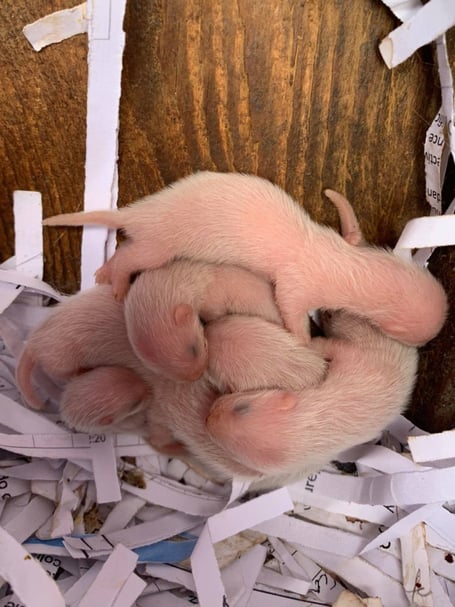
We had a lovely surprise last week when a ferret, who was recently handed in to us, gave birth to a litter of five babies, called ’kits’.
They are all doing well, and will be ready to go to new homes in six to eight weeks once they are weaned.
Ferrets are, quite literally, domesticated pole cats and are members of the weasel family.
It’s thought that they were first domesticated over 2,000 years ago and so they have had a long association with humans.
-(1).jpeg?width=209&height=140&crop=209:145,smart&quality=75)
.jpg?width=209&height=140&crop=209:145,smart&quality=75)
.png?width=209&height=140&crop=209:145,smart&quality=75)
.jpg?width=209&height=140&crop=209:145,smart&quality=75)
This is probably because they are relatively easy to train, and can be kept either as pets or as ’working animals’ in that they can be used to hunt smaller mammals such as rats and mice.
Most pet ferrets have been babies, like ours, who have been born to a domesticated ferret (a ’jill’), but some are born wild and then tamed.
Male ferrets are called ’hobs’ and they are bigger than females, with some growing up to 24 inches in length (equivalent to a medium-sized dog!).
Owning a ferret is described as ’having a kitten that never grows up’ because they love to play, they are extremely affectionate if well-handled from an early age, and they are incredibly inquisitive about their surroundings.
They can become very attached to their human owners and, in equal measure, be very aloof around strangers.
However, because they are intelligent they get bored easily and so need lots of stimulation.
They tend to be active in short bursts, usually at night, and then sleep a lot during the day - so much so that they can give the impression of being lifeless.
This is called the ’ferret dead sleep’ and can, understandably, cause owners great deal of anxiety.
Keeping ferrets in pairs is recommended because they can amuse each other and they are great fun to watch, puffing up their tails as they tag each other, and giggling as they play hide and seek.
Ferrets can be de-sexed, following veterinary advice, which avoids the complications of unwanted kits and may also help with any smells associated with keeping them in a domestic environment because most of the smelliness comes from their reproductive glands.
They can also be trained to use a litter tray and they are not necessarily any smellier than a dog or cat if a good standard of husbandry is maintained.
They are a big responsibility, not least because they can live for up to 10 years.
An added complication is that when a jill comes in to season she will remain in heat until she is mated, and this can make her very ill and lead to her death.
They also like to steal things, from food to car keys, and hide their stash away in secret caches.
In the wild pole cats are hunters and foragers, and there is no guarantee of another meal being readily available.
It makes sense, therefore, to stockpile or hoard any uneaten food, and to keep it in reserve for when it’s needed in the leaner winter months.
Even though domesticated ferrets don’t have the same food supply issues as their wild cousins, the hoarding instinct is ingrained and is an evolutionary urge.
They can be very stealthy and imaginative when it comes to finding hiding places, which can be problematic if an owner can’t trace a pile of fruit or a slice of meat before it goes rotten, or their car keys!
Comments
This article has no comments yet. Be the first to leave a comment.