
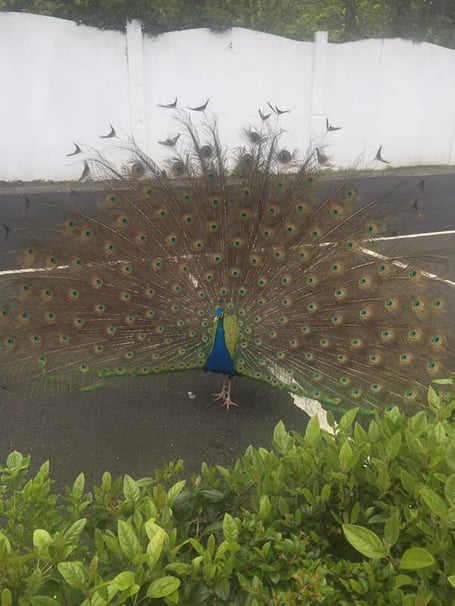
We have received more calls about peafowl (peacocks and peahens) this year than any other species of bird.
As many visitors to a well-known Douglas supermarket will know, a peacock and his partner are regularly seen roaming around in between cars or sitting on top of them (something which peafowl seem to enjoy doing).
These birds and others are now venturing further into Douglas and they’ve been spotted in Athol Street, Strand Street and Circular Road.
The birds are flying in from the woodland on the outskirts of Douglas where they eat a natural diet of berries, seeds, insects and worms, but it seems they are venturing into urban areas in search of ’fast food’.


.jpeg?width=209&height=140&crop=209:145,smart&quality=75)

A number of Douglas residents are feeding the birds and encouraging them to stay, which is inappropriate because they are noisy and messy, and they do not make good neighbours - some local residents are regularly kept awake or woken up by the birds’ screeching.
The peafowl are very adept at evading capture and fly off as soon as a net appears, and so the only way forward is for people to stop feeding them.
A word of caution: a person who regularly feeds peafowl may legally be seen as the birds’ keeper and therefore responsible for their actions.
For all they are a nuisance, these beautiful birds have to be admired for their adaptability.
They are native to India and were brought to the UK in the 1800s as exotic additions to country estates.
They seem to thrive in our cold, wet climate and, although they have a penchant for sitting on cars, they are good in traffic and we have not had any reports of peafowl being run over (unlike poor pheasants, which seem to fly deliberately into passing cars).
Although we have no way of measuring the peafowl population on the Isle of Man accurately, the number of sightings reported to us continues to grow, month on month, and so their numbers are undoubtedly increasing.
The adult birds have no natural predators, such as foxes, here on the island and they are breeding successfully.
Peafowl owners need to take more responsibility for their birds.
It is illegal to release non-native species into the wild because of the impact they can have on our native wildlife.
Ideally the birds should be provided with an environment that gives them an incentive to stay in one place - plenty of food, roosting spaces and the company of other peafowl.
Ideally they should be kept in a large enclosure with overhead netting, and their eggs should be collected to avoid unwanted chicks.
The peafowl breeding season is April to September, and a peahen generally has just one clutch of between five and seven eggs per year.
How many people who like the idea of keeping peafowl understand what this entails, and appreciate that these birds normally live for about 15 years, but some have been known to live as long as 30 years â?¦
Wing clipping birds’ flight feathers is a very controversial issue, with some saying that restricting a bird’s natural movement and ability to fly is cruel, and could endanger them if they are unable to flee from a predator like a dog; and others arguing that it’s better and safer to keep the birds in one place.
If you are considering wing clipping please ask your vet for advice first - there are lots of videos on the internet showing you how to do it, but if it is done incorrectly it can cause the bird a great deal of pain.
Keeping all our animals contained during TT fortnight is a huge priority for pet owners and farmers. If you live near the course please double check your boundary fencing in case it’s been damaged, and keep dogs and cats indoors during the racing if at all possible.
Comments
This article has no comments yet. Be the first to leave a comment.