
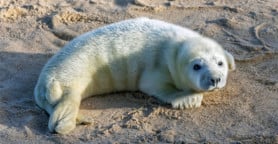
This is the time of year when we start to receive calls from the public about seal pups appearing to be stranded or abandoned on our beaches, especially after stormy weather.
We’re on hand to give advice about specific sightings, and we will always investigate a seal that appears to be in distress, but the vast majority of seal pups don’t need any help.
Both the Atlantic Grey seal and the Harbour or Common seal can be found in Manx waters.
In the autumn, females come on to land to give birth to a single pup.


Usually they pick remote locations, such as the Calf of Man, although sometimes pups can be seen on the mainland too. Other spots to see them include Niarbyl, Langness, the Point of Ayre and Maughold Head.
The female leaves her pup while she goes out to sea to hunt for food and so a passer-by may assume the pup has been abandoned.
She will come back to shore every few hours to feed her offspring. While her pup will rapidly put on the pounds, she will lose about a quarter of her body weight.
After only three to four weeks the pup will weigh about three times its birth weight and will be weaned.
It will then need to live off its fat reserves until it learns to find food for itself.
Brutal as it sounds, the mother seal does not spend time with her pup showing it what to eat and how to feed, and the youngster has to rely on instinct for its survival.
stormy
Seal pups tire easily, particularly in stormy weather and rough seas, and they will haul out onto the nearest beach or rocks which then makes them vulnerable to human, and canine, disturbance.
We work closely with Manx Wildlife Trust to assess seal pup strandings and sightings.
Unless the pup is visibly seriously injured we always wait for a turn of the tide in anticipation that the pup will return back out to sea on a high tide.
Seals are protected by the Wildlife Act 1990 and so it is illegal to disturb them unnecessarily.
We ’interfere with nature’ as a very last resort, and on an exceptional basis we bring seal pups to Ard Jerkyll if they have been injured, or they are obviously unwell.
A veterinary practice in the north of the island is providing much-needed support, too, and recently helped with a very young pup, just a day or so old, that simply would not go back out to sea.
The vets have successfully tube fed the pup and now have it drinking fish soup from a bottle. It requires a great deal of expertise to do this because seal pups are very difficult to handle.
Seal pups might look cute and fluffy, but they can be aggressive and they have a ferocious bite.
They’re also good at ’playing dead’ and so you must never approach, or touch, one even if you think it’s lifeless - simply observe from a distance of at least 50 metres, ideally 100.
It goes without saying that children and dogs must also be kept well away, and that they must be quiet and calm in order to minimise any stress their presence may be causing the pup.
Unless you have genuine reasons to be concerned for a seal pup’s health, leave it alone.
Not only will you stress the pup, you may scare off its mother if you crowd around it.
And don’t post images of the pup on social media, especially if its location is easily identifiable from the photographs.
We’re incredibly lucky to have these amazing animals in Manx waters and we need to treat them with the respect they deserve.
Comments
This article has no comments yet. Be the first to leave a comment.