
It’s seal pup season and we’ve spent the last few days fielding telephone calls from members of the public who are concerned that a pup is in distress and needs our help.
We’re on hand to give advice about specific sightings, and we will always investigate a seal that appears to be in distress, but the vast majority of seal pups don’t need any help.
Both the Atlantic grey seal and the harbour or common seal can be found in Manx waters.
In the autumn, females come on to land to give birth to a single pup.
.jpeg?width=209&height=140&crop=209:145,smart&quality=75)

-(2).jpeg?width=209&height=140&crop=209:145,smart&quality=75)

Usually they pick remote locations, such as the Calf of Man, although sometimes pups can be seen on the mainland too.
The female leaves her pup while she goes out to sea to hunt for food and so a passer-by may assume the pup has been abandoned.
She will come back to shore every few hours to feed her offspring, and while her pup will rapidly put on the pounds, she will lose about a quarter of her body weight.
After just three to four weeks the pup will weigh about three times its birth weight and will be weaned.
It will then need to live off its fat reserves until it learns to find food for itself.
Brutal as it sounds, the mother seal does not spend time with her pup showing it what to eat and how to feed, and the youngster has to rely on instinct for its survival.
Seal pups tire easily, particularly in stormy weather and rough seas, and they will haul out onto the nearest beach which then makes them vulnerable to human, and canine, disturbance.
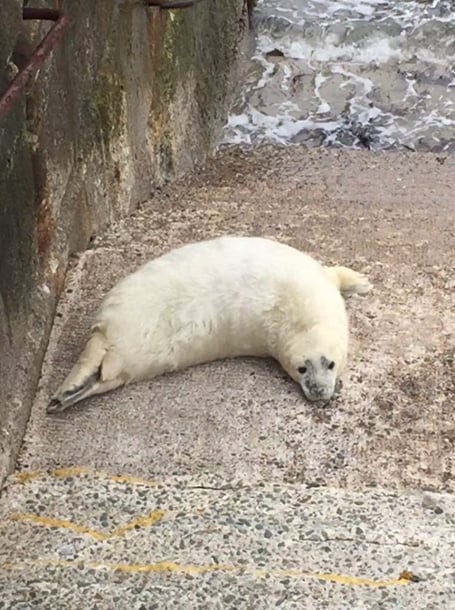
The pup pictured decided that the steps leading up to Douglas promenade were a good place to rest, and it snoozed contentedly for several hours seemingly unaware of the human interest it was creating.
We worked with Manx Wildlife Trust to cordon off the area around the pup, waiting for the tide to come back in so that we could gauge its reaction to the water.
Once the waves started to splash the pup, it tried to climb higher up the steps and would have ended up on the busy promenade, which was our cue to intervene.
It clearly did not want to return to the water just yet, and needed extra time to rest.
So, we covered it with a towel and placed it in a large dog crate, and then transported it to a nearby, secluded beach where it could continue sleeping.
It was good to see an adult seal already on the beach when we arrived, confirming that it is a ’seal-friendly’ environment.
We ’interfere with nature’ as a very last resort, and on an exceptional basis.
We only bring seal pups to Ard Jerkyll if they have been injured, or they are obviously unwell, and our aim is to keep them in our seal pens for as short a time as possible while they undergo treatment.
Seal pups might look cute and fluffy, but they can be aggressive and they have a ferocious bite. The Douglas promenade pup showed us a very fine set of sharp white teeth when we approached it, even though it was still sleepy.
A fine set of teeth is, sadly, not something Toothie the cat can boast about - she has only four left.
She was brought to us as a stray from Onchan where she had spent several weeks in a gentleman’s back garden eating the food he had been putting out for hedgehogs.
She’s a stunning, jet black cat but she is very nervous and is scared of her own shadow.
She finds the cattery environment very stressful, and doesn’t come out to meet people when they enter her pen and so she’s being over looked.
She is a sweet, gentle cat and simply needs a quiet home to call her own, where she can grow in self-confidence.
She deserves to live the second half of her life as a much-loved family pet, given her hunting days are over and she can no longer fend for herself.
Comments
This article has no comments yet. Be the first to leave a comment.