
Did you know that, according to UK statistics, you are more likely to be involved in a fatal road accident on a rural road than on an urban one?
Given the Isle of Man is predominantly rural and had no speed limit on many of its roads, the problem is a real one at any time of year
But now that we’re in the midst of winter when bad weather and poor visibility are at their worst, a reminder about road safety seems appropriate – whether you are an animal owner or not.
All road users have an obligation to be visible.


Please think again if you are that car driver who doesn’t automatically put their headlights on at this time of year, whatever the time of day.
The low sun, when it is shining, can make visibility difficult especially if you have a dirty windscreen.
And are you one of those cyclists who dresses all in black, with a small red light on the back of your bike?
Most horse riders will need to ride on the road at some point, whether it’s to reach an off-road route or to connect one bridleway to another.
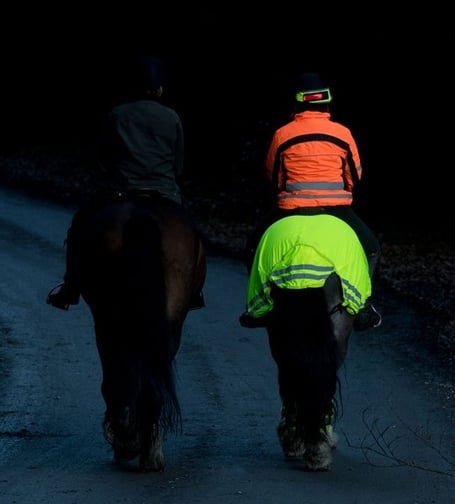
There is, sadly, still a minority of horse riders who do not kit themselves and their horses out in hi-vis, reflective clothing and equipment.
Wearing hi-vis when you’re using the road can give other road users extra time to react, which could save the life of both you and your horse.
Horse riders, no matter how young, should know their signals when riding on the road to make sure other road users know what they intend to do.
This is especially important when approaching junctions, passing a hazard or turning off the road.
And all road users should remember to take their mobile phones with them in case they need to call for help; but although it’s tempting to check your phone for calls and messages, using your mobile phone whilst driving or riding is illegal and very dangerous.
It can be very frustrating to be in a vehicle that’s stuck behind a cyclist or horse, especially when the latter is plodding along at five miles per hour.
But please be patient.
Horses are prey animals and no matter how well schooled and calm they normally are, they can still be unpredictable and become frightened by something they perceive to be a threat (a new road sign, for example, or a plastic bag in a hedge).
Just as with cyclists, please don’t curse horse riders who are riding two abreast – this is legal and it can help to make the ‘obstruction’ shorter and more defined.
There are lots of other road safety tips that even experienced driers should re-familiarise themselves with:
- When driving on winding roads slow down ahead of the bend and not once you enter it, and anticipate another road user being just out of sight.
- Fresh manure on the road could indicate that there are horses, cattle or sheep just around the next corner; and fresh mud on the road could be a sign that a slow-moving tractor may be just ahead of you.
Usually a tractor isn’t going very far and it won’t be long before it pulls in to a farm or field, so be patient. But bear in mind that a tractor may swing out to the right before turning left due to its size.
- Hidden dips (which make it difficult to see oncoming traffic) are a feature of many Manx roads. Do you know what the warning sign for a hidden dip looks like?
- If you see a bird or wild animal in the road sound you horn and swerve to avoid it if it’s safe to do so.
Deliberately running over a bird or animal is a criminal offence.
We inevitably need to share our roads, so let’s do this with respect for other road users – whether they’re humans or animals.
Comments
This article has no comments yet. Be the first to leave a comment.