
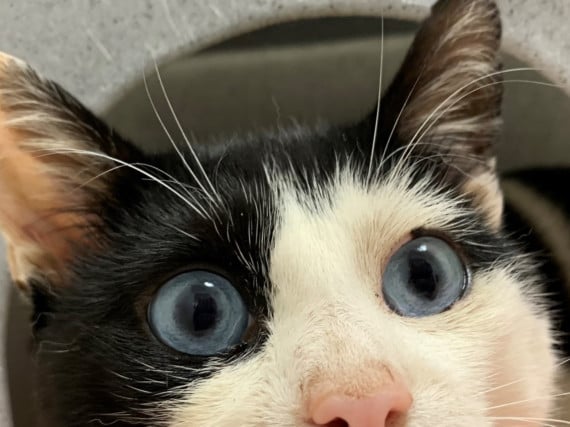
A cat’s eyes are remarkable in that they respond to light levels, allowing the cat to see in near-darkness in order to hunt prey.
A cat’s eyes are also a ’window into their soul’, and they can give you a good sense of how your cat is feeling - emotionally and physically.
Narrow pupils signal that a cat is aroused and that its senses are heightened.
Watch your cat’s pupils become narrow slits the next time they spot a bird through the window, or when they sit on your lap and purr for attention.


-(1).jpeg?width=209&height=140&crop=209:145,smart&quality=75)

Wide pupils, on the other hand, can be a sign of both excitement and fear, and so you will need to look for other body language clues such as a ’bottle-brush’ tail, which indicates that a cat is scared.
Wide pupils can also be a sign of abject terror, something which many cats experience when they have to travel in a car.
What if a cat’s eyes are different sizes?
When one pupil is larger than the other this indicates that a cat has a condition called anisocoria.
Anisocoria is a symptom of a medical problem, and not a disease in itself, and it can indicate that the cat has:
a brain injury due to trauma, such as a fall or being hit by a car
an injury to the surface of the eye
a problem with the nerves running to the affected eye
glaucoma, a very painful build up of pressure in the eye
a retinal disease, and possibly cancer.
Different sized pupils can also be a sign of the feline leukemia virus, which affects a cat’s immune system and for which there isn’t a preventative vaccine.
You should seek immediate veterinary advice is you notice your cat’s pupils have developed anisocoria to lessen the chance that your cat’s vision will be permanently affected, or an otherwise undetectable head injury is left untreated.
A cat’s pupils are an incredibly expressive part of your feline’s body language repertoire, and help you to know how they are reacting to certain stimuli - enabling you to do more of the good things and to avoid unnecessary fear.
They could also help you to save your cat’s life.
Cats’ eyes, in the form of reflective markings on our roads, have also saved the lives of many thousands of humans.
They were invented in 1934 by a Yorkshireman called Percy Shaw, who was inspired by how a cat’s eyes reflect light.
He developed a reflective lens from strips of polished steel and the rest, as they say, is history.
The ’catseye’ is now considered to be one of the most influential designs of the 20th century, alongside the design of Concorde and the World Wide Web.
The spectacular eyes in the picture belong to Ozzy, a young cat whose previous owners didn’t like his tendency to roam and so they gifted him to us.
He’s only just been castrated, though, and so he’s likely to stay closer to home once his hormones settle down.
Blue eyes are not as uncommon in cats as you might think, given most cats have green or yellow coloured eyes, but they are usually found in breeds like Siamese and Burmese.
Ozzy is a black and white ’moggie’ and so we think his eye colour is due to a recessive gene.
Ozzy is a very friendly and affectionate cat, and it won’t be long before a new owner falls in love with him - once seen, forever smitten.
Comments
This article has no comments yet. Be the first to leave a comment.