
The ManxSPCA operates a trap, neuter, return (TNR) programme in relation to feral cats, and in doing so helps to manage feral numbers on the Isle of Man.
Feral cats are more susceptible to illness and disease, and they have a relatively short life expectancy, often dying a slow, painful death.
Because of their high mortality rate, ferals fill the void by reproducing as frequently as possible and most feral females will have two litters a year.
Over a 10-year period it has been estimated that an unneutered female, and her unneutered progeny, can produce around 40,000 offspring.




Feral colonies often come into conflict with domestic cat populations, and the problem is not an isolated, rural one - it’s on our doorstep.
Feral cats often carry feline diseases that can be passed onto domestic cats, particularly when they are fighting or mating.
One feline disease, in particular, is a cause for concern because there is no vaccine for it, and so responsible cat owners can’t protect their pets against it.
It’s called ’Feline Immunodeficiency Virus’ (FIV) and it has been likened to the human disease, HIV/AIDS.
The ManxSPCA’s TNR programme involves setting up humane cat traps in the area where a feral colony seems to be centred.
The traps need to be monitored on a frequent basis to ensure a cat is not kept confined for longer than necessary, and the society relies on the public’s support in many cases to do this.
The trapped cats are then brought to the society’s cattery quarantine unit, where the cattery team’s expert handling skills are required - feral cats are usually fast and furious!
They are then booked into see a vet as soon as possible, so that they can be neutered or spayed, and then released with the minimal amount of time spent in a pen.
While sedated, the feral cats are ’ear-tipped’ by the vet, which means that they have a centimetre of one ear cut off in a straight line - this is the internationally recognised way to demonstrate that a feral has been neutered or spayed, and it helps prevent them being trapped for a second time.
While at the veterinary surgery feral cats are also tested for FIV.
Historically, the society’s policy was to put to sleep cats who tested positive, on the basis that they would, inevitably, die a protracted death from the disease.
However, it now operates a policy whereby it will rehome an FIV-positive feral who shows signs of domesticity - i.e. he or she is comfortable around humans and is happy to be indoors (such a cat is likely to have been a stray who has become feral).
A rehomed FIV positive cat will need to be the only cat in a household, and live out their life as an indoor cat so that the disease can’t be spread.
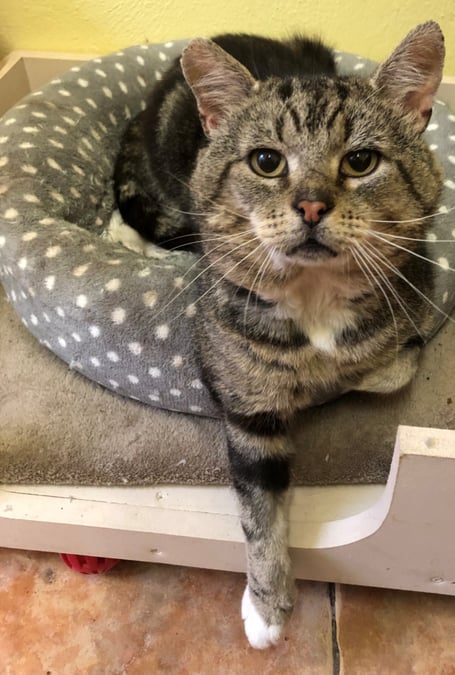
We have one such cat in our cattery at the moment - handsome Tubbs.
He has very chubby cheeks that are a sign of FIV and we think he’s deaf and he is very sensitive to the touch around his head.
Otherwise, he is in good health and he sleeps contentedly for much of the time.
We think he’s about 10 years old but it’s hard to age him exactly.
What we can be sure about, though, is that he has a super personality and that he will be an ideal and constant companion for his new owner.
He will be perfectly content indoors, enjoying all the home comforts, and this will undoubtedly extend his life span. He’s a very clean cat, too, and always uses is litter tray.
If you would like to meet this special boy, please come to Ard Jerkyll between 1pm and 4pm any day apart from Thursdays.
Comments
This article has no comments yet. Be the first to leave a comment.