
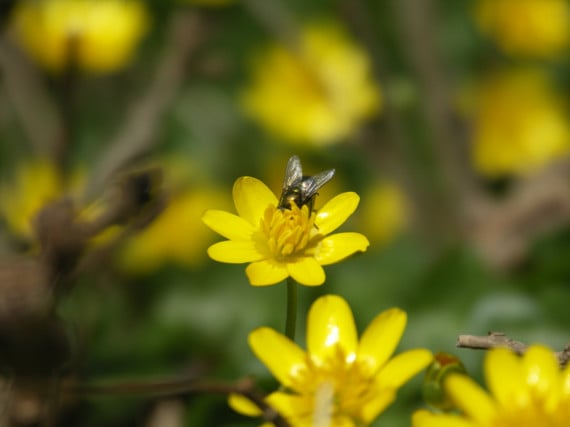
February’s challenge to you is the sighting of the lesser celandine flowers.
These lovely little yellow flowers are a lovely indication that spring really is on it’s way.
The word ’celandine’ comes from the Greek chelidon meaning ’swallow’ and traditionally they appear on the first of February.
These cheerful flowers are glistening yellow but often turn whiter with age.



They are 20 to 30 mm in diameter, with eight to 12 narrow elliptical petals.
They have dark green heart shaped leaves on long stalks, which are hairless.
Celandines are related to buttercups, although the greater celandine is related to poppies, stand a lot taller and found in meadows.
Where are you likely to find it?
Look for them on woodland and hedge banks, particularly damp places, in meadows and also along stream-sides. Have you noticed how many spring flowers are yellow by the way?
This is because yellow is the colour that appeals most to insects and flowers are trying to out compete each other for the pollinators.
Lesser celandines are an important early food source for queen bumble bees when they emerge out of hibernation.
What information do we need you to give us?
We need a location, an address, or map reference or GPS reference from your mobile phone.
There are many great apps you can download for this, as well as using Google maps.
We also need the date and time, your name, and a contact number or email for you, in case of any queries we may have and if possible a photograph.
We would love to share your photographs on this page about your findings.
To contact us, you can go via the Manx Wildlife Trust Facebook page and message us, or email [email protected]
You can also telephone us on 844432.
So get out there searching for us.
Remember, wildlife counts! Thank you!
Please don’t forget our last month’s challenge to keep an eye out in your garden ponds and when walking by ponds for the lovely big masses of frogspawn in the water.
We already had one sighting of frogspawn in early January.
However, given the cold snap that we have had it is unlikely that they would survive and it will also deter frogs from laying spawn over the period.
Also we would like to remind you not to take frogspawn from one pond to another.
Ponds are carefully balanced environments and you could introduced invasive species unwittingly into your pond.
* The Manx Wildlife Trust is the island’s leading nature conservation charity with more than 300 acres of land as reserves, and we are promoters and champions of the wonderful wildlife and habitats in, on and around our beautiful island and keep a close eye on what is happening to it.
We are asking people this year to become extra eyes and ears for us to help us monitor the islands rich biodiversity.
Your observations and sightings really do help us and are valuable, we have set up an email especially for you to record your findings and it’s [email protected]
Comments
This article has no comments yet. Be the first to leave a comment.