
The Manx Wildlife Trust is the leading nature conservation charity in the Isle of Man.
It protects the fragile local wildlife by creating living landscapes, living seas and encouraging and fostering a society where nature matters.
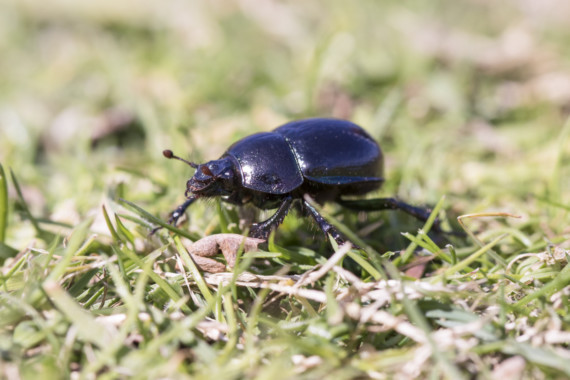
This month we are getting excited about dung beetles!
We would like our citizen scientists to keep an eye out for these wonderfully helpful beetles.



It is possible to find dung beetles active all-year round, as several species are winter active, although the majority are found in the spring, summer and autumn.
There are approximately 60 species of dung beetle in the UK.
They are not the ’ball rollers’ seen in warmer countries, where they seem to spend their time rolling balls of dung here and there.
Instead our dung beetles either live inside the dung pile, and are known as ’dwellers’ or in the soil beneath it, earning them the nick-name ’tunnellers’.
Dwellers usually spend their entire life in the poop, although the larvae of some species are found just under the soil surface.
They might be a beetle which is under estimated for their value but they provide a range of ecosystem services.
Dung beetles (Scarabaeoidea), for example, are a ’superfamily’ that support a number of ecosystem functions.
The list of services provided by these helpful little beetles is huge, such as aiding soil fertilisation and reducing greenhouse gases by burying the dung, improving ground drainage and enhancing soil structure by digging tunnels and turning over soils.
They also disperse seeds, keep parasite numbers down and act as a food source for birds, bats, badgers and some other mammals.
All members of the Geotrupidae, also known as ’Dor beetles’, excavate vertical burrows in which the eggs are laid, earning them the common name of earth boring dung beetles.
Many species produce a noise by rubbing the upper section of the hind legs together. This is called stridulation and it is used in mating communication or sometimes as a defence mechanism.
Unfortunately, dung beetles are in decline and a few species are already thought to be extinct.
Some of the reasons for this decline include over-wintering livestock in barns, instead of fields, short-term rotation grazing when fields are left for long periods without animals, converting fields to other uses and using chemicals such as fertilizers and worm treatments, which remain in the animal’s dung.
Also, imported animal breeds often have runnier poo, and our poor dung beetles can actually drown in it.
We would like you to report any sightings of dung beetles to the Manx Wildlife Trust.
Remember to include the date, the type of species seen, where you saw it and your name and contact details in case of queries.
Photographs are always a bonus too, and you can email them to us at [email protected]
If you have any questions, feel free to phone us on 844432.
Our records are passed to the NBN Atlas Isle of Man which anyone can access.
by Dawn Colley
Biodiversity Education Officer
www.mwt.im
Comments
This article has no comments yet. Be the first to leave a comment.