
Looking at how plastic can end up harming the island’s environment, our reporter Jess Ward gets in touch with the Manx Wildlife Trust (MWT).
It’s time to end the plastic problem in the Isle of Man.
Using their recent #ManxPlasticPledge, this is exactly what the Manx Wildlife Trust aims to do, by urging residents to ’give up’ one item of single-use plastic from their daily routines and share about it on social media.
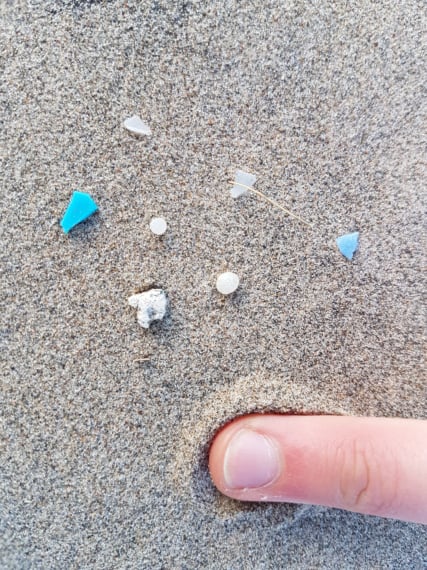
However, another serious plastic menace has been highlighted, but this time in a lentil-sized form: ’nurdles’


.jpeg?width=209&height=140&crop=209:145,smart&quality=75)
.jpg?width=209&height=140&crop=209:145,smart&quality=75)
Marketing and membership manager Graham Makepeace-Warne said: ’Nurdles on the island are a fairly recent discovery, as we actively looked for them following the issue being raised across.’
The plastic pellets can make their way onto our beaches from containers falling off ships, which are travelling around the world to factories.
Pellets could be lost due to spillages at the factories, which mould them into products like plastic bottles.
These nurdles can then escape down drains or rivers that will take eventually them out into the deep blue until they wash ashore somewhere.
So why should we be worried?
The MWT advises: ’As with all plastic, they will gradually break down over time into smaller and smaller pieces. Unfortunately our marine life around the island can mistake the plastic for food and eat it.
’The plastic can travel up the marine food chain starting with zooplankton which are then eaten by small crustaceans like krill, which are eaten by small fish and up the food chain it travels!
’But nurdles also act like magnets in the oceans and harmful chemicals stick to their surface and concentrate on the nurdles, which when eaten (ingested) by the marine life can concentrate in their layers of blubber (fat) and make them ill.’
The discovery of these unwanted nurdles has resulted in the MWT organising open Nurdle Hunts.
Biodiversity education officer Dawn Dickens led a Nurdle Hunt on Port Erin beach this month.
About 30 participants picked up 378 tiny plastic pellets in one hour.
Since nurdles are so small, they can be difficult to find, but Graham has some helpful tips:
â?¢ Search at the ’highest part of the beach above the high tide line’, as the pellets are light and can easily be blown up there.
â?¢ Check where there is a lot of sand, grasses or try near paths.
â?¢ Make sure to wash your hands afterwards or use tweezers and gloves, as nurdles have concentrated chemicals on them.
Graham explained that a lot of plastic that is found on our beaches does come from offshore.
’However, we must also accept responsibility for plastics that blow in to the sea and end up elsewhere,’ he said.
’Much of the plastic found on our beaches and in our rivers is lightweight so that it blows away or floats on the water and this gives us a clue as to how it gets there.
’Although littering in the island is less of an issue than in some other places, the locality of litter on roadsides and over walls/hedges shows that it is largely thrown from cars or by passers-by.
’The obvious effect is direct physical harm such as rope around a seal’s neck or fishing tackle wrapped around a seagull’s leg, but this is just the tip of the iceberg.
’We now know that plastics leach toxic chemicals into the sea but also absorb toxins before being ingested by wildlife.
’What is perhaps more alarming is that microplastics, and the toxins they absorb, are entering the food chain at the lowest level and ending up in our own diet.
’It’s imperative that local people lead the charge by reducing their reliance on single use plastics.’
’In doing so, they will put pressure on local businesses to support them through removal of plastics in products and packaging,’ Graham added.
Comments
This article has no comments yet. Be the first to leave a comment.