
The history of dogs has been inextricably linked to the history of man for the past 10,000 years, which is when dogs started to live alongside people.
The domestication of dogs can be attributed, in the main, to the need for them to have a regular source of food, but the desire to interact with humans is also a factor.
Dogs are social animals, able to form strong attachments, and this is undoubtedly why they are considered to be ’man’s best friend’.
But this popularity has come at a cost for dogs in the western world, and many have paid a large genetic price.




Although selective breeding has taken place for centuries, the Victorians were the first to create a set of standard breed points based on a dog’s looks and conformation and not just based on the role the dog undertook.
As we have discussed before in these articles, some types of dog have unhealthy breed requirements such as very short noses that make breathing difficult, very long bodies that create spinal problems, or wrinkly faces that cause eye defects.
Interestingly, though, the first ’modern dog’ did not (and still doesn’t) have health issues associated with its breed type.
So, what was the first ’modern dog’?
University of Manchester historians have identified him as a pointer called Major - a description of Major was found in an 1865 edition of a Victorian journal called The Field, and it was the first recorded attempt at defining a breed standard based on physical form.
Although pointers had been bred as gun dogs for many years before 1865, and valued for their ability to find game, they came in a variety of sizes and colours. Once the pointer’s breed standards were defined, these variations were phased out of the ’pedigree’ dogs and the following criteria were developed:
Noble, steady dog showing power, endurance and speed, giving the immediate impression of an alert and energetic dog whose movements are well co-ordinated.
Of medium size, with a short back standing over plenty of ground.
Grace of outline, clean-cut head, long sloping shoulders, deep chest, short back, powerful hindquarters, good bone composition, adequate muscle, well carried tail and taut coat.
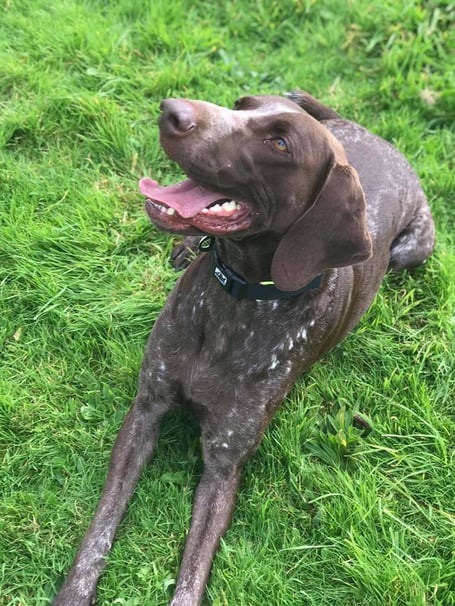
Gus, the three-year-old German pointer pictured, is a very fine example of his breed and he looks and acts as he is ’designed’ to do.
His previous owners describe him as friendly, happy, enthusiastic, clever and playful, but their failing health has forced them to make the difficult decision to rehome him.
Gus still thinks he’s a puppy and so he can be a bit excitable and strong on the lead, and so he needs an energetic new family who will be able to keep up with him. He’ll also need new owners who are prepared to continue with his training, making sure he respects his boundaries and understands right from wrong.
Gus’s previous owners have told us that he chases cats, and so he needs to live in a cat-free household.
And, because he doesn’t know his own strength, it would be unsafe to rehome him with young children.
Gus gets on with most other dogs but we’re told that he really doesn’t like black dogs.
This is quite a common issue in the canine world and may be because black dogs are more difficult to see. Their body language isn’t so obvious and so other dogs can’t predict how they’ll react.
If you are interested in finding out more about Gus please contact the kennels team by calling 851672, and selecting option one.
It’s sometimes difficult for the team to answer the telephone when it rings, especially in the mornings when they are busy cleaning and walking the dogs
So, please leave a message on the answer machine rather than simply hang up, and a member of the team will call you as soon as they can.
Comments
This article has no comments yet. Be the first to leave a comment.