
It seems that most of us are in for a ’staycation’ summer, giving us more time to spend walking along our rural and coastal footpaths, and in our glens and plantations - and so a reminder about the dangers of ticks is now due.
Ticks can’t fly or jump. Instead, they climb into long grass or vegetation and lie in wait for a host to pass by and to brush past them, so that they can attach themselves and start to suck blood.
If several ticks attach themselves to a small mammal, like a hedgehog, or to a bird they can cause anaemia or create an infection, which can kill the host.
Ticks can be tiny and hard to spot, but once they have gorged themselves on blood they can grow to the size of a thumbnail.




They then drop off their host when they have had enough, usually after a few days.
Larger mammals don’t die from anaemia like the smaller ones, but they can become infected by a potentially fatal bacterial illness called Lyme disease. Dogs, cats and humans can all get Lyme disease, although it is uncommon in cats.
Symptoms in dogs and cats include: lethargy, loss of appetite, fever, lameness, painful joints, and swollen lymph nodes.
If caught in its early stages, Lyme disease can be treated with antibiotics by your vet, and so contact your veterinary surgery straight away if you are concerned.
Prevention is better than cure, and so please make sure your dog or cat is up-to-date with their flea and tick treatments, available as ’spot-ons’ or tablets, which kill or repel unwanted blood-suckers.
If you do notice a tick on your pet, don’t try to remove it by pinching or squeezing it, which may result in the tick’s head being left in the skin.
This can push blood back into your pet which will increase the chances of them getting infected.
Ideally you should use a tick removal tool, which can be picked up from your veterinary surgery or local pet shop where staff will be able to give you advice about how to use it.
Don’t try to burn them off, or use Vaseline or nail polish to suffocate them, or alcohol to poison them - all ’urban myths’ which run the risk of making a bacterial infection more likely.
Lyme disease in humans is becoming more commonplace.
Recent research indicates that the total number of Lyme disease cases in the UK in 2019 could be as high as 8,000.
If caught early the disease can be successfully treated by the use of antibiotics, but if left untreated it can cause serious, permanent damage to joints and the nervous system.
The disease has many symptoms which makes it difficult to diagnose. In about a quarter of cases a circular, red rash develops around the bite, and in many cases a person develops ’flu’ like symptoms such as lethargy, aching joints and a high temperature.
If you have been out in the countryside and you show these symptoms, you must seek immediate medical advice.
In order to protect yourself whilst outdoors, the advice given by Lyme Disease UK is to:
Spray yourself and your clothes with insect repellent
Avoid walking through long grass, and stick to pathways
Wear long sleeves and tuck trousers into socks (not the best look, but worth it!)
Take a shower and check for ticks when you get home.
They can look like tiny black dots if they haven’t fed, and so are hard to spot.
All the rescue animals at Ard Jerkyll are fully up-to-date with their flea and tick treatments.
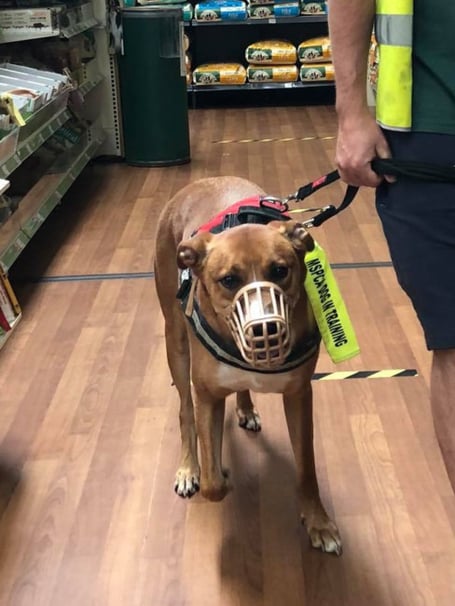
Jeff is pictured shopping in a local pet shop perusing the shelves for the latest treatments.
He wears a muzzle in public as a precautionary measure because he’s a big softie and enjoys being around people.
But Jeff is strong, and he’s very playful (he’s only four years old) and so his new owner will need to able to manage his bounciness, and give him the active lifestyle he needs.
Comments
This article has no comments yet. Be the first to leave a comment.