
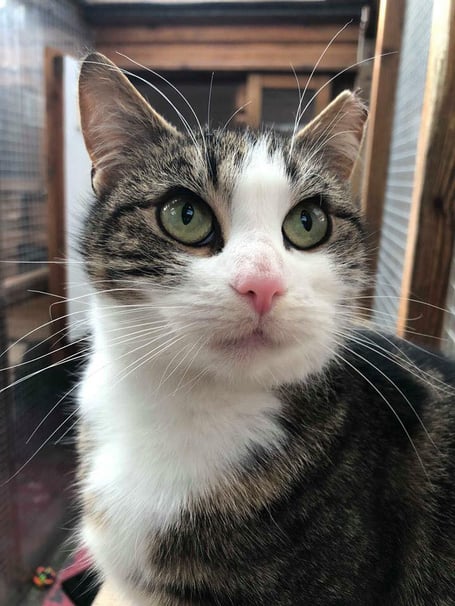
Do you know what to do when a cat wanders into your house or garden, looking lost?
A recent Cats Protection charity survey in the UK showed that 42% of people would look for a collar and check to see if it had an owner’s details, but only 20% would consider taking the cat for a microchip check.
There are a few other things that help to ascertain whether a cat has an owner.
If the cat has the tip of one ear missing (a quarter of an inch, cut in a straight line, on the left ear), this means he or she has been neutered or spayed as a feral in the past and is still likely to be feral, and therefore won’t have an owner.

.jpeg?width=209&height=140&crop=209:145,smart&quality=75)
.jpeg?width=209&height=140&crop=209:145,smart&quality=75)

Although it may seem cruel, ear-tipping is an internationally-recognised method of being able to check visually whether a feral cat has been neutered or spayed, without the need to trap it for closer inspection.
This means that cats are not captured for a second time unnecessarily.
Even a close visual inspection of a female cat does not always tell a vet whether she has already been spayed and investigative surgery is often the only option - and, so, ear-tipping prevents a female being operated upon twice.
The ear-tipping must be done by a vet, under general anaesthetic, and so discomfort for the cat is minimised.
Trog, pictured, was what we call a semi-feral who had already had his ear tipped, and he found a home earlier this year.
If you are interested in providing an environment for feral or semi-feral cats, where they have sufficient food and shelter, please contact the cattery team.
Feral cats are a great method of natural rodent control.
A sure-fire way of encouraging a cat, whether it is lost or not, to stay in your garden or to come into your house is to feed it and so this should be avoided even if the cat seems hungry.
We receive lots of calls from people who don’t intentionally feed a strange cat but can’t avoid doing so because the cat comes through their cat flap and eats the food put down for the household cat.
Most pet shops sell magnetic cat flaps, which only open for a cat who is wearing a collar with a small magnetic device attached to it, and so they keep out unwanted visitors.
Alternatively, you can encourage the strange, potentially stray, cat into a cat box and take it to your local veterinary practice or bring it to us at Ard Jerkyll for ’chip-checking’.
Provided the microchip company has up-to-date owner’s details it should be fairly simple to reunite the cat with its family, and put your mind at rest.
And don’t forget that the ManxSPCA’s Lost and Found Pets Facebook page is an interactive site that tells you about animals who have gone missing and ones that have been found.
Hundreds of cats go missing on the Isle of Man every year because it’s in a cat’s nature to enjoy roaming and exploring their surroundings, particularly if they are not neutered or spayed, and they are notoriously fickle when it comes to where they sleep.
Microchipping really is the most effective way to make sure your precious feline is able to be identified, and so please support June being the UK’s National Microchipping Month by ensuring your cat is chipped and that your details are up-to-date on the microchip company’s database.
Microchipping dogs will become a legal requirement on the island this October, but please don’t leave it until the last minute to ensure your dog undergoes this simple, painless procedure.
All of our dogs, cats and rabbits are microchipped as part of the adoption package, and they are neutered/spayed and vaccinated - all the more reason to ’adopt don’t shop’.
Comments
This article has no comments yet. Be the first to leave a comment.