
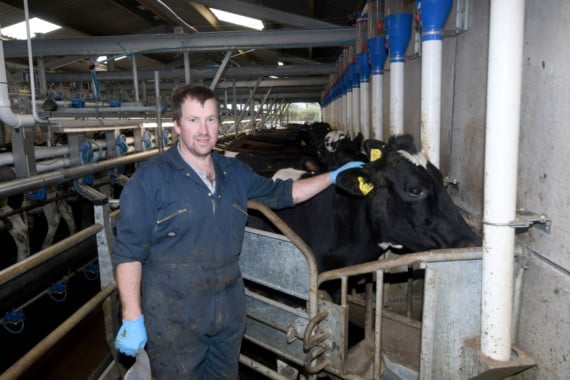
Ballagawne Farm, run by brothers David and Robert Cooil, won the Farming Award at DEFA’s Food, Farming and Fishing Awards.
So what was it that impressed the judges?
We just showed them what we do and how we do it and explained why we do what we do, says David Cooil.
And that really sums it up because this is a farm where nothing happens by accident: it has all been thought through.


In fact it’s not just one farm but three, totalling 500 acres, in the south of the island.
There’s Ballagawne Farm in Ballabeg where David lives with his wife and two children and where they keep their dairy herd.
Then there’s Ballacreggin Farm in Port St Mary, where Robert lives with his wife and their four children, and further land at Ballakilpheric where they fatten around 120 cows a year.
David took over the farm in Ballabeg when his father retired and he soon realised that changes would have to be made.
He says: ’We were doing beef and sheep because that’s what we’d always done.
’We used a farm advisor, Chris Kneale from the Rural Business Consultancy, extensively from the start.
’We’ve always benchmarked the farm and with the beef and the sheep we could never get it to be profitable without the Single Farm Payment: we always needed that government money.’
They decided that dairy would be the way forward and the brothers took on a ’massive’ loan to build a shed, a milking parlour and a dairy herd.
The cows were sourced in Wales and are a mix of Friesian and Kiwi crosses, a small New Zealand breed which is essentially a Friesian/Jersey cross.
David says: ’We’ve had really good support from Isle of Man Bank: we worked closely with Lindsay Leece, their business advisor, and hopefully, once we’ve paid off the loan, the farm will be profitable.’
They had everything in place to start milking the cows in the spring of 2017 and by the end of this month they will be milking 200 in all.
David says: ’We split block calve: we calve 80 cows from September 7 for nine weeks and then we calve 120 cows from February 7 for nine weeks. It spreads the milk across the year.
’We rotationally graze the cows.
’We try to get them out on grass as early in the year as possible so, in the early and late parts of the season, we use on-off grazing.’
This means that the cows go out for two or three hours in the morning straight after milking, then they are brought back in and given silage to eat before going back out after afternoon milking for another couple of hours and brought back in for the night around 9pm. David explains the reason for this regime: ’They’ll eat 75% of what they can consume in a day in the two or three hours after milking.
’Then you get them back in, to stop them standing in corners and making a mess, and you give them a bit of silage just to fill the gap.
’It’s just for a few weeks till the fields dry and the grass growth gets strong enough to sustain them - as early as possible but it’s very weather dependent.’
David and Robert also plate metre the grass once a week to measure its growth and use a computer programme called Agrinet which gives them a ’grass budget’ so that they know how long each paddock will last.
This is supplemented through the winter with good quality silage.
Welfare is important as David explains: ’We don’t chase litres: our cows will only be doing an average of 6,000 litres whereas housed cows in the UK, they’ll be hoping to get 10,000 litres.
’The Creamery’s grass-fed scheme is a good thing as well: that’s what we farm towards, more of a grass-based, minimal-cereal diet.’
They also took up another of Chris Kneale’s suggestions and had the whole farm soil sampled.
David explains: ’This allows us to target fertilizer and slurry use better.
’We were blanket treating the whole farm with what was probably expensive fertilizer but, once we’d soil sampled it all, we could put the right fertilizer in the right fields or not put any on fields that don’t need it.
’We will always need fertilizer but we are starting looking at ways to reduce our use of it through targeting and better use of the slurry.’
The brothers benefit from each other’s support in the day to day running of the farms, as David explains: ’We get on really well and we both work well together.
’We share responsibility: I do the lion’s share of the mornings and he does a few to give me a morning off.
’Then we work together in the afternoon and through the day we’ve got our jobs like feeding the calves then we sort the milking out and get finished. It’s important to us both that we work around the kids: we start early in the mornings and get finished to get back to have breakfast with them and take them to school and then we try to be finished by six in the evenings as well to get back to see them before bed.
’And, because there’s two of us, we can also have a day off sometimes, and spend time with them.’
If you saw the pictures of the awards being presented you will have noticed that it was David by himself receiving the award.
If you’re wondering where Robert was, that was just another example of them sharing the jobs as David explains: ’Robert wasn’t there on the night: he was milking.
’He doesn’t like going to things like that!’
Comments
This article has no comments yet. Be the first to leave a comment.