
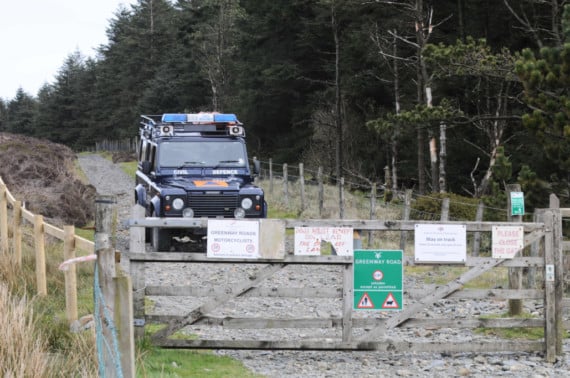
A controlled explosion was expected to be carried out this morning to dispose of two discarded mortars at Sartfell.
The shells, which could be of Second World War origin, were found on Monday by a dog walker on the unmade road leading from Brandywell towards Ballaugh and Kirk Michael.
Sergeant Andy Reed of Peel police station said they thought heavy rainfall had eroded the surrounding soil leaving just the tip of one of the explosives exposed and visible actually on the track.
Speaking yesterday, he said: ’The army are due over on the first ferry tomorrow and will be met by Constable John Hills who is our explosives officer who will take them to the site.’
 Man showed picture of his genitals to teen he was mentoring on her first day in job
 Conditional discharge for man caught with cannabis too small to register a weight
.png?width=209&height=140&crop=209:145,smart&quality=75) Isle of Man Steam Packet vessels enter dry dock for planned surveys
Isle of Man Steam Packet vessels enter dry dock for planned surveys Manx Telecom Launches Christmas Offers with Boosted Roaming and In-Store Support
Since their discovery, the mortars have been guarded inside a cordon set up by the island’s Civil Defence team and by police.
Sergeant Reed said army experts had used the photographs emailed to them to identify the item as a two-inch mortar.
’Apparently they could be training mortars that produce smoke or they could be proper live ones but they can’t tell from the pictures.
’I’m told the area was used as a training ground from the Second World War up to the 1970s or 80s, so they could date from any time in that period,’ he said.
Ian Young, of the Civil Defence team, said they would be continuing to maintain a cordon around the area overnight until experts arrived on Thursday morning.
The book 20th Century Military Archaeology, by Paul Francis, published by Culture Vannin, refers to military exercises carried out near Sartfell.
The reader is told: ’Exercise Longstop was a reproduction of the capture of Longstop Hill in Northern Tunisia and this was carried out near Sartfell. From there cadets were marched to a point near Killabrega and from there an attack on Mount Karrin about 1,000 yards away. This distance had to be crossed in 10 minutes amidst a hail of bullets, bombs and shells, which represented artillery fire. There were machine guns on the hills that were flying over the heads of the cadets.’
The Home Guard, based at Cronk-y-Voddy, also used it: ’The Battalions were formed into a number of companies. There were 52 observatory posts. There were training operations during the summer of 1942 and 1943 based at Glen Wyllin for specialised training and field exercises in the area sleeping at the cafe.’
Comments
This article has no comments yet. Be the first to leave a comment.