
Mitsubishi has updated its hugely popular L200 pickup - but will it be enough to tempt buyers out of their cars and SUVs? Darren Cassey finds out.
WHAT IS IT?
The L200 has been an ever-present in the Japanese car maker’s line-up for more than four decades. Here, it’s been updated for its sixth generation, and Mitsubishi hopes it’ll tempt buyers out of cars and SUVs.
WHAT’S NEW?

.jpeg?width=209&height=140&crop=209:145,smart&quality=75)
.jpeg?width=209&height=140&crop=209:145,smart&quality=75)
.jpeg?width=209&height=140&crop=209:145,smart&quality=75)
This has been a fairly comprehensive update for the L200 and includes new technology such as LED lights. Inside, it’s been given a going over to make car owners more comfortable switching across, while the extensive safety kit on offer at higher trim levels is genuinely impressive for the price point.
The diesel engine is more refined and more economical. However, arguably more important changes come in the form of a strengthened chassis and updated suspension.
WHAT’S UNDER THE BONNET?
The turbo-diesel engine has been downsized slightly to 2.3-litres, and while it’s about 15bhp down than before at 148bhp, refinement and economy are said to be improved. The most important figure for commercial users is likely the decent 400Nm of torque, which proved useful when we tested it in towing situations.
Fuel economy is measured at 32.1mpg for the six-speed manual and 29.1mpg for the six-speed automatic, figures that were easily attainable during our test of the truck. CO2 emissions are rated at 231g/km.
WHAT’S IT LIKE TO DRIVE?
Compared with the old model, the L200’s on-road manners are much improved. It handles better, suffers less from wind noise and is more comfortable over road imperfections. The automatic gearbox is responsive, and the engine is quiet at cruising speeds. It’s easy to tool about town in thanks to its narrow frame and high bonnet.
Commercial buyers will find this to be one of the more refined pick-ups, only behind the VW Amarok, which isn’t quite as capable off road, and the Mercedes X-Class. However, those jumping out of a car will likely find the wind noise a little too intrusive still, while the fidgety ride could grate if you never have the need to carry heavy loads.
HOW DOES IT LOOK?
From a distance, the L200 might look quite similar to its predecessor, but look more closely and you’ll realise there’s actually been quite an extensive overhaul. It’s most noticeable up front, where the headlights are now slimmer, while the blades either side of the grille give it a more purposeful appearance and bring it in-line with the rest of the Mitsubishi range.
WHAT’S IT LIKE INSIDE?
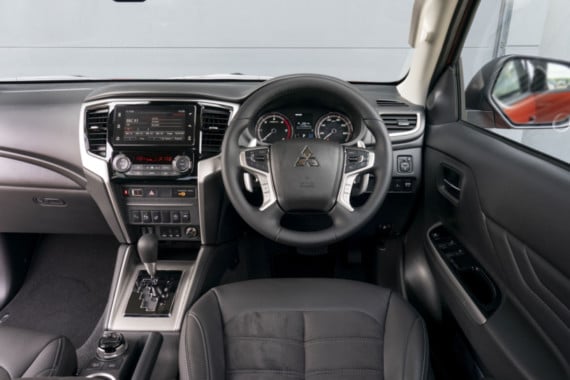
Mitsubishi might want to ease the jump from road car to pick-up truck for private customers, but the L200’s interior still feels rather agricultural. The infotainment system screen could do with being a little larger, and the slew of chunky buttons give a decidedly retro air to the cabin.
VERDICT
Look at the Mitsubishi L200 as a purely commercial prospect and it makes a lot of sense. Its off-road capabilities are impressive and its towing capabilities are fantastic, for example. The fact it can do all of this while feeling more refined and offering impressive equipment levels without breaking the bank makes it an appealing prospect.
Despite those points though, those looking for something that’s merely a practical alternative for an SUV might still struggle to make that leap.