
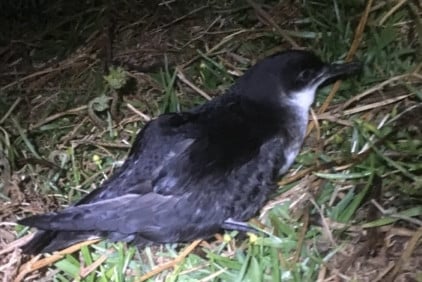
Visitors to the Curraghs Wildlife Park have funded a project on the Calf of Man.
The park’s conservation fund supports conversation projects around the world and this year includes a donation to help Manx Wildlife Trust with the recovery of Manx shearwaters on the Calf of Man.
The money is collected from donations in the admission price to the wildlife park, which is in Ballaugh.
It will be used to buy night vision cameras and other equipment to monitor the birds as they come ashore at night.
.jpg?width=209&height=140&crop=209:145,smart&quality=75)

The Manx shearwater (puffinus puffinus) was originally described from a specimen most probably obtained from the Calf of Man, where there were, historically, significant numbers of breeding shearwaters.
As many as 10,000 young were harvested every year in the 17th century.
This exploitation appeared to have little or no detrimental effect on the numbers breeding on the Calf but the accidental introduction of the brown rat (or longtail to the superstitious) to the island, allegedly as the result of a Russian shipwreck in 1781 caused a catastrophic decline.
By the beginning of the 19th century, the shearwater colonies on the Calf were all but wiped out.
Although various efforts to eradicate or reduce the effects of the rats, following the establishment of the Calf of Man Bird Observatory in 1959, had some success it was not until 2000 that breeding of the shearwaters was again confirmed.
In 2012 the Calf of Man’s owner, Manx National Heritage, and the managers of the bird observatory, the Manx Wildlife Trust, began the Manx Shearwater Recovery Project.
The project monitors rat activity and the breeding fortunes of the shearwaters.
Although eradication of the rats from the Calf has not been entirely successful, it has reduced the population sufficiently that only one or two sightings are made annually.
This has allowed the Manx shearwater population to continue to expand along the east coast of the Calf and at a couple of more isolated sites on the west coast of the islet. There was an estimated population of 650 pairs in 2019.
Monitoring of these populations is carried out annually by the Calf wardens with the help of students from Bangor University.
Calf of Man bird warden Aron Sapsford said: ’The Manx shearwater is a true marine specialist, spending most of its life at sea and only coming ashore to breed.
’They are rather ungainly on land and due to the risks of predation will only come ashore during the cover of darkness, which means that despite being such an iconic bird for the Isle of Man they are rarely seen.
’We are really excited to team up with the Curraghs Wildlife Park as part of their Conservation Fund, with the sponsorship of night vision cameras which will be used to film the night-time comings and goings of shearwaters as they return to breed on the Calf of Man in 2021.’
Wildlife Park general manager Kathleen Graham said: ’The Wildlife Park has ambitious aims to help conservation around the world this year.
’We combine our work with the species that we keep safe and care for here at the Wildlife Park in the Isle of Man with protecting the populations in the wild
’As a member of The European Association of Zoos and Aquaria (EAZA) and the British and Irish Association of Zoos and Aquariums (BIAZA), we have four target conservation projects to support this year - humboldt penguins in South America, black blue eyed lemurs in Madagascar, silvery gibbons in Java and, very importantly, Manx shearwaters right here in the Isle of Man.
’The conservation of species is a global effort however we must not forget that conservation on your doorstep is key.
’We are really pleased to be teaming up with Manx Wildlife Trust and it is important for our visitors to know that just by visiting the Wildlife Park you are contributing to conservation as well as having a good day out. We would like to continue our support of this local conservation project for the years to come.’
Leigh Morris, the chief executive officer of the Manx Wildlife Trust, said: ’I know from my two years working for the Royal Zoological Society of Scotland that there are a great many people who visit zoos, aquariums and wildlife parks that would never visit a local nature reserve.
’This collaboration with the wildlife park will therefore significantly raise the profile of Manx nature conservation to all their visitors and provide funding that will make a positive difference to our monitoring and communication about the Manx Shearwater colony on the Calf of Man. Huge thanks to the wildlife park and hopefully this is the start of a long lasting collaboration between us.’
Comments
This article has no comments yet. Be the first to leave a comment.