
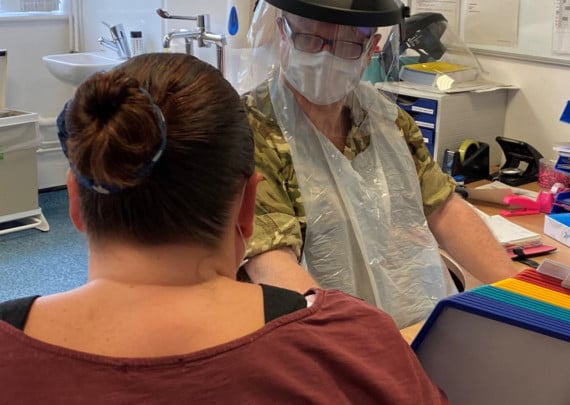
Army Corporal Kyle Hoy, from near Ballasalla, served on the frontlines of the pandemic helping to deliver vaccines in England.
He was part of Operation Rescript - which was the UK’s biggest domestic military operation in peacetime to tackle the Covid-19 crisis.
During this early part of this year, Kyle helped to administer vaccines at a mass centre, a GP surgery and then as part of a mobile team to vaccinate housebound patients and those in care homes.
He had been expecting to take some leave at his base at Christmas, having been unable to return home to the island to spend the time with his family due to the border restrictions.
.jpeg?width=209&height=140&crop=209:145,smart&quality=75)
.jpeg?width=209&height=140&crop=209:145,smart&quality=75)
.jpeg?width=209&height=140&crop=209:145,smart&quality=75)
However, he was then notified by command that he would be deployed as part of the quick reaction taskforce to help the NHS with the vaccination rollout.
The pace of the work was busy, with more than 600 vaccinations being delivered by Kyle’s team over an average 12-hour shift at the vaccination hub at a sports centre.
Asked how the pandemic compared to his past deployments, Kyle drew parallels with his experience helping to combat the ebola pandemic in Sierra Leone in 2014.
In particular, the emphasis on educating the community to change behaviour - he talked about how funeral traditions had to be changed in Sierra Leone.
’With Covid, I would say it’s exactly the same, you’re trying to educate people on things like "hands, face, space",’ Kyle said.
’Even though Covid’s an airborne virus and ebola virus [spreads] more from contact, the dynamics are a little bit different but it’s very similar - it’s about education.’
For simple things like the proper protocol for donning and removing PPE, his experience of dealing with ebola benefited him over those junior medics who did not have his same background of working with infectious diseases.
He said that the army had been so effective in fighting ebola in Sierra Leone, that what was expected to be a two-year deployment was accomplished in just one.
Reflecting on the fulfilling parts of his deployment, Kyle told us how it was nice to see military veterans among those who they vaccinated in care homes or in their own homes.
There were some who had served in the Falklands and Gulf War, and Kyle said they were always keen to chat and ask him questions about the operation he was on.
He also enjoyed being part of a close-knit team of six, with whom he worked in an isolation bubble.
Kyle said: ’It’s also the guys I was working with that made it [the experience].
’There was one navy chap, one army nurse from a Birmingham hospital, two RAF medics and an RAF doctor. And we had a bit of a laugh on our downtime as well.
’So it was really, really good in that sense.
’And the job itself - meeting the public was great.’
Speaking about his career path, Kyle told us that after Castle Rushen High School he joined up at 17.
He did so because ’half of his family’ had served in the military, like his father (who was in the Royal Irish Regiment), and it also offered the chance to see the world.
Though a medical role was not his first choice, he liked the sound of it when he was told about it by experienced personnel, and the potential for additional training and progression appealed to him.
He is currently working on his EMT (Emergency Medical Technician) qualifications, with a view to qualifying as a paramedic at some point during his Army career.
Having finished his duties as part of Operation Rescript in March, Kyle then went for a time to RAF Cosford to help with vaccinating military personnel.
For now, he is back to his regular duties serving as the manager of a medical treatment facility in Warwickshire before going on to join a new unit in October.