
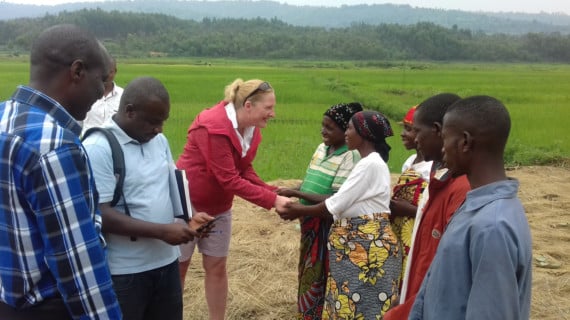
Louise Whitelegg, the Isle of Man’s Christian Aid co-ordinator, has just returned from a self-funded trip to Burundi to meet her colleagues from the charity and get to know the people of this east African country.
Here, in the first of a series of articles, she reflects on her welcome to one of the world’s poorest countries.
As the grey skies and winter weather persist I found myself with a significant birthday on the horizon and cold bones.
Never being one to shy away from a challenge or to miss an opportunity, I decided to celebrate in style with a self-funded trip to visit my Christian Aid colleagues in one of the world’s poorest counties. Burundi is the focus country for this year’s Isle of Man Christian Aid Week appeal so what more of an invitation did I need?
.jpeg?width=209&height=140&crop=209:145,smart&quality=75)

Burundi is very small proportionally to the rest of Africa. It is located in the east and landlocked with Tanzania, the Democratic Republic of Congo and Rwanda.
I arrived after a long, convoluted journey, on my birthday, to a kind of heat from which there is no escape other than to kick off one’s shoes, slow your pace and go with the flow.
The airport I landed in, though to service the capital of the country, Bujurmbura, is more akin to something that you would find in an Agatha Christie African adventure.
I found myself left behind in the airport, with the gentleman who has been my companion on the flight, and a very old, frail lady, as the sparse number of my fellow travellers disappeared through bureaucracy.
The lady boarded the plane in Rwanda, with the assistance of the staff, but then was unceremoniously left in the airport as soon as their job was done.
It transpired that this lady, who was nearly blind, could not write or read and only spoke the local language of Kurundi, was a failed refugee being returned home by South Africa where she had escaped to as an economic refugee.
To further complicate the situation the papers she had were in English and no one in the airport could read the documents to translate sufficiently to complete the entry documents. Goodness only knows what my Christian Aid colleagues thought of my delayed exit through the airport. Welcome to Burundi!
Here are some comparisons with the Isle of Man.
Both are small communities where everyone knows everyone. Both are nationalistic and proud, Christian, have their own language, a strong agriculture background and are looking at how to bring ’fresh’ money in to the economy.
Both are beautiful places and have no speed limit!
Here are some tips on how to drive in Burundi.
In fact, the speed limit is optional and controlled by pot holes. They generally drive on the right but the centre of the road is fine.
Signalling with your left-hand indicator keeps you safe and lets the other driver know that you are coming through regardless.
Night time is even more fun because main beams come in to play. You get to indicate as well as flash your main beams at every opportunity. Additional fun can be gained from waiting until someone is about to pass and then flash your lights.
Pot holes - which is a kind description that includes streams running through roads and no roads - are a government ploy to slow the traffic. Just to make things more interesting there are then speed bumps that are the same colour as the road.
So you drive like a maniac on the flat bits of road that you find then brake sharply to a stop when you meet a pot/speed bump hole.
You have to sit in the car like you are riding a wild horse and hold on with both hands. Pay attention to the road and your driver otherwise the bumps catch you unaware and you end up in your colleague’s lap.
Travel tablets are essential, along with a very strong bra!
â?¢ See the Examiner next week to read the second instalment of Louise’s travelogue which looks at the issue of faith in Burundi.
Comments
This article has no comments yet. Be the first to leave a comment.