
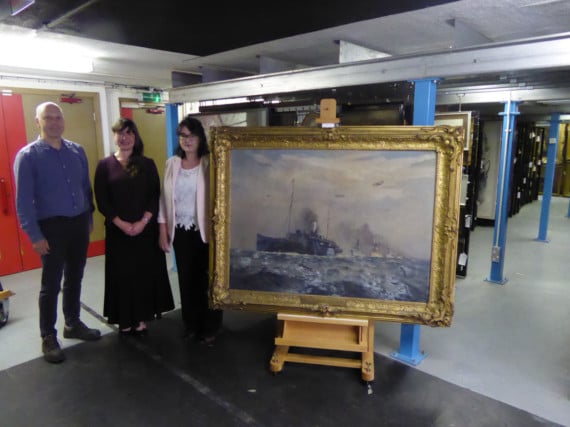
Three paintings from the island’s National Art Collections set sail for conservation in the UK this week, thanks to support from the Isle of Man Steam Packet Company.
The paintings are set to go on display in a new gallery dedicated to the island’s military history, opening at the Manx Museum in 2018.
The gallery will feature stories, manuscripts and objects including weapons, costumes and paintings related to the island’s role in armed conflict.
Included in the collection is an oil on canvas portrait featuring Major James Spittal, a commander of the Douglas Rifles Volunteer Corps. The portrait, which dates to 1900, will be cleaned and minor damage to the gilded frame repaired by expert conservators.

.png?width=209&height=140&crop=209:145,smart&quality=75)


A second portrait featuring Robert Farrant MHK of Ballamoar, dated 1795, will also be conserved.
MNH conservator for objects Chris Weeks said: ’Many decades ago the painting was damaged by water, resulting in the canvas support and frame swelling then shrinking.
’The damage has resulted in paint becoming loose and flaking. The flaking paint will be stabilised by injecting resin in solution. The painting will also be cleaned to remove old varnish and unsightly retouching, then filled, retouched and re-varnished. The frame, also original, requires similar treatment.’
The King Orry and her mainly Manx crew had served with the Royal Navy throughout the First World War.
Symbolically the King Orry, the only merchant ship amongst the elite vessels of the amassed British and German navies, is shown leading the surrender of the German Fleet. Behind the King Orry is HMS Phaeton, leading a column of seven German Light Cruisers.
Chris said: ’Having no glazing, "Surrender of the German Fleet", has become very dirty and it now requires careful cleaning. Some of the paint has begun to degrade leaving a white deposit on the surface of the sea in the foreground.
’The white deposit is caused by fatty acid salts from bitumen used as a brown-black pigment in the paint and will be carefully removed.
’The surface of the painting will also be analysed, enabling MNH to minimise further decay of the paint.’
Comments
This article has no comments yet. Be the first to leave a comment.