
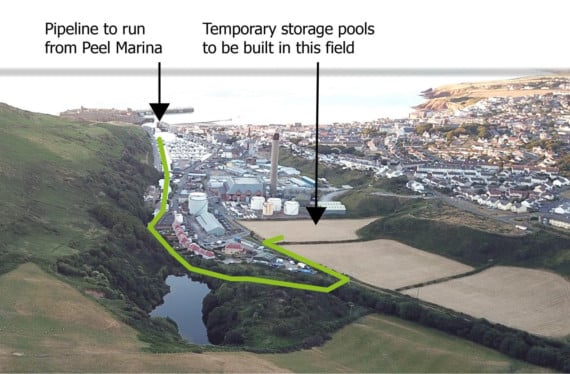
Dredged silt from Peel marina is to be stored and drained in a lagoon constructed on the outskirts of the town, under plans lodged this week.
Under the proposals, the dried sediment will ultimately be used to restore land blighted by mining in the 19th century.
A planning application has been submitted for the storage and disposal of contaminated silt from the marina.
If dredging does not take place, accumulation of the silt threatens the closure of a number of berths within the marina, which was last dredged in 2015.


.jpeg?width=209&height=140&crop=209:145,smart&quality=75)

A project to remove 44,000 tonnes of silt is due to begin next year and will take place in distinct stages.
The first stage will involve a proportion of the material being removed from the marina bed by excavator and transported a short distance by road to a temporary pool constructed in a field upstream, beyond the Power Station site.
Most of the silt will be pumped along a pipeline back up the River Neb to the pool, which will be around 2.5 metres deep and will measure roughly 70m by 100m.
This process will take place in the spring of 2019 and 2020, in order to avoid migrating fish.
The second stage of the project will see the material being temporarily stored in the pool for up 18 months. Excess water will be pumped back to the marina after satisfying environmental standards agreed with the Department of Environment, Food and Agriculture (DEFA).
A third and final stage of the project will see the dried sediment used to restore contaminated and eroded land next to the former Cross Vein Mine, off the Round Table Road, near Foxdale.
The silt in the marina is contaminated by heavy metals from the old mine working upstream.
But DEFA says the sediment is significantly less contaminated than the dust found at Cross Vein Mine and specialists are confident the material will help reinstate the damaged land as an attractive upland habitat.
A comprehensive environmental impact assessment will be undertaken and remediation work will include measures to restrict further sediment loss from the site.
In doing so, this will reduce the amount of material entering the watercourses that flow into the marina, where it causes significant and costly access restrictions. Reducing sediment flow is also likely to improve salmon and trout breeding locations in the Neb catchment.
A detailed transportation plan will be in place to ensure the safe transfer of materials from Peel to Cross Vein.
Tim Baker MHK, DoI member with responsibility for ports and chairman of the Peel Marina Project Board, said: ’The proposed solution offers significant long-term benefits for both Peel Marina and the uplands.
’A lot of hard work and creative thinking has gone into getting us to this stage, and building the temporary pool will be the first stage in allowing it to succeed.
’While the planning application is for five years, the intention is for the pool to be in place for a maximum of three, and the field will be restored after the project is finished.’
He added: ’As this project takes place, further work will be undertaken to reduce the accumulation of silt and contamination levels in the Neb.’
The plans will be placed on public display at Peel Town Hall in Derby Road, Monday to Thursday, December 17-20.
Comments
This article has no comments yet. Be the first to leave a comment.