
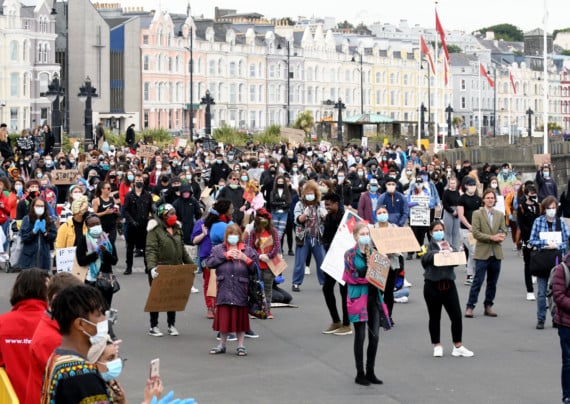
This week marked a year since the Black Lives Matter march on Douglas Promenade, where more than 1,000 people protested against racism.
The killing of George Floyd, who was black, by white police officer Derek Chauvin in the USA last May sparked a wave of protests worldwide.
Activist group PoC (People of Colour) Isle of Man - which has also just celebrated the first anniversary of its founding - feels that the march sparked a wide meaningful conversation about the experience of ethnic minorities who live in the island.
We went to the group to see if they thought the situation had changed since June.



education
Spokesperson Daniyel Lowden said that he felt ’a lot of education had happened in a short space of time’, but that such systemic issues could not be solved within a year.
Among the positive advances made in the past year, Mr Lowden cited the good engagement that the group had from the talks it had conducted in most of the island’s schools, and from politicians such as Clare Barber MHK and Jane Poole-Wilson MLC, with the latter tabling a Tynwald debate on institutional racism last July.
He also said there had been a lot of positive engagement from the police, adding: ’A lot of other police forces around the world have not acted the way the police have here.
’They’ve really tried, they got our support to do anti-racism training, and they are so quick to get back to us about anything that we need with regards to race and racism.’
Mr Lowden went on to say that the group had also been speaking with the Department of Education, Sport and Culture, and that there had been a ’big push’ to diversify the curriculum.
He told us this would include ’positive black stories, to decolonise it, to be more reflective of what the experience of non-white people was in Britain, in regards to the slave trade, and maybe the Manx history in relation to that as well’.
Speaking about the wider debate on race which June’s march prompted, Mr Lowden said: ’It’s been really positive the way that, as an island, a lot of people have embraced this conversation.
’I’ve been having conversations with [people’s] aunts and uncles - even the older generation that didn’t necessarily have to engage in that conversation before.
[But] since the march, and since it was so in your face and everyone knew about it - I feel that this time last year, every single family had to have that conversation about what racism looks like on the Isle of Man.
’And I don’t really feel like that had happened before, to that extent.’
He explained that this conversation would be important going forward, as more people of colour move to the island.
However, Mr Lowden said that improvements still needed to be made.
In particular, there was the lack of hate crime legislation, which is something that PoC IoM has been pushing for and speaking with MHKs about, as a priority for the next year.
He noted incidents the group had been aware of where people had been physically attacked because of their race, but currently there was no mechanism to specifically prosecute for this. Mr Lowden said that overall, the strides made since last year had been positive, though there had also been the inevitable backlash.
’[For] the whole population of the Isle of Man, public opinion has changed really drastically really quickly [since the march], he said.
’I feel like especially within our generation, 20s and younger - there’s a huge push to really diversify and be inclusive with what the Isle of Man looks like.’