
The gender pay gap has been growing and Policy and Reform Minister Chris Thomas has already admitted the Equality Act will not be a ’silver bullet’ to combat it - but the government has to make sure it reduces the imbalance.
Cutting the gender pay gap is a challenge the Council of Ministers has set itself in the Programme for Government, although its main point of refence for addressing this comes via the Equality Act.
Mr Thomas, pictured inset, has acknowledged it will take more than that piece of legislation.
He remains hopeful the act, designed to combat discrimination in the workplace, will help - along with other measures.


-(1).jpeg?width=209&height=140&crop=209:145,smart&quality=75)

However, he said dealing with the disparity was much more than a legal or workplace issue and needed to be addressed from an early age.
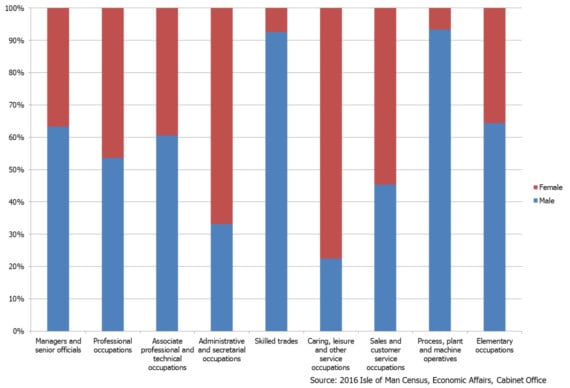
The fact the gender pay gap has increased has been put down, partly to the growth in certain sectors, including e-gaming and ICT, where, traditionally men have dominated the high-earners.
Also, the size of the population in the Isle of Man means that comparatively small shifts in strengths of different sectors of the workforce can have a dramatic effect.
The last annual earnings survey saw the average wage at £685 per week.
But the average for men was £775 and the average wage for women was £566.
Women doing manual work actually saw their pay go down.
Mr Thomas said the pay gap was caused by a number of factors.
It included the more easily recognisable discrimination - both direct and indirect - but also included the undervaluing of women’s work in the labour market, and a preference for either men or women in different economic sectors.
The government has already been called on to improve the gender balance in senior roles and also promote maternity arrangements and flexible working, in order to help level the playing field.
Earlier this year, the minister admitted: ’The Equality Act cannot be the silver bullet in all of this.
There are going to have to be many more fundamental policy responses.’
The gender pay gap has fluctuated, dropping to below 10% in the Isle of Man in 2014 - as illustrated in the accompanying graphic - but it has risen sharply, back to more 15%, in the past two years.
Although, when looking at the chart, particularly how the Isle of Man compares with the UK, the change in direction appears alarming.
Mr Thomas added a caveat: ’Because we have a relatively small labour market and economic sectors, as certain sectors have changed we have seen dramatic differences.
’We have got a diversified economy, but not as diversified as the UK.
He insisted, however, that the Manx government was taking any trend seriously.
Mr Thomas said that addressing a gender pay gap and gender bias had to start early.
That included ensuring that, even in the early stages of education, boys and girls were not subjected to stereotypes concerning future roles and careers.
Changes in attitude needed to be brought about at all stages, he added.
Many women will attest to having, at some stage, having faced sexism in terms of their work, or even finding a job.
One of the issues that many younger women may have faced is a potential employer seeking to know what plans, if any, they have to start a family in the future.
While the law does not specifically prevent an employer from asking such a question, any potential employer who did so could leave themselves open to being taken to an employment tribunal on the grounds of sex discrimination, should the interviewee not get the job.
Another issue that has been identified as an area to address is equal pay for equal work, which many believe is a route to reducing the gender gap.
Wider issues such as government’s approach to population growth could also have an influence, said Mr Thomas.
If certain demographics are targeted, they could influence the pay gap.
Not least, if young people starting families are a target for population growth.
The Howard Quayle administration has made a commitment, in its Programme for Government, to grow the economically active population and a policy paper is on the horizon.
But, said Mr Thomas, work was needed across the board to try to address gender pay gap.
’It is for us to work with businesses, to work with education, industry and generally, to make sure that the opportunities are there equally,’ he said.
Where discrimination is identified, it can be tackled.
’There is a legal basis for that.
’If it is discrimination that is keeping things back, there is a legal mechanism to address it.’
But, he added: ’It is not only a question of legal discrimination, it is a question of views formed over the years.
’People are influenced by their parents, in schools and in society.’
Comments
This article has no comments yet. Be the first to leave a comment.