
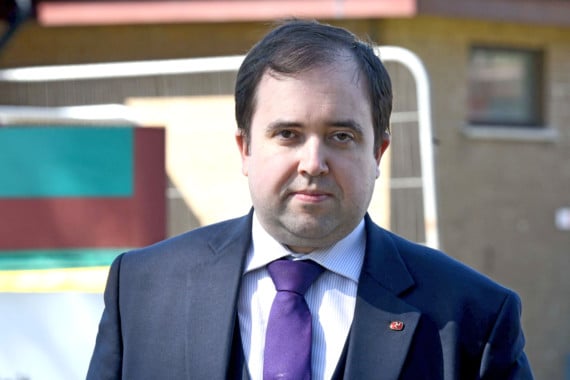
Chief Minister Howard Quayle has admitted he is nervous as the island prepares for the next phase of border re-opening.
But earlier this week he insisted the government has no plans to alter next week’s border relaxations in the face of case increases in the UK.
From Monday, people travelling between the island and the rest of the British Isles who have had both Covid vaccination doses - administered in the British Isles, with at least two weeks since the second dose - will not be subject to any testing or isolation requirements upon arrival here.
He admitted: ’I am nervous. I have never tried to hide that.
 New organ donation law to come into force as island urged to ‘make informed choice’
 Department outlines new education priorities as Tynwald receives updated plan
.jpeg?width=209&height=140&crop=209:145,smart&quality=75) Tynwald rejects referendum on Isle of Man's Net Zero policy
Tynwald rejects referendum on Isle of Man's Net Zero policy Operating the Isle of Man’s Liverpool ferry terminal costs more than £710,000 a year
’But I believe now is the right time to move forward in a balanced way.’
The measures are a remodelled version of previous plans to fully unlock borders and were approved by Tynwald last week.
Mr Quayle said he understood concerns about the UK situation and the government would act if necessary.
But the vaccination programmes in the UK and the island had vastly reduced the number of hospitalisations from Covid-19.
’Should something happen in the interim we will of course come back to Tynwald with changes.’
Mr Quayle was responding to an urgent question permitted in the House of Keys, tabled by Claire Christian (Douglas South). She said hospital cases in Lancashire had trebled in one week and argued mitigations including test and release and face coverings would help with the border changes.
She wanted to know whether the planned border changes were under review ’given the continuing level of cases in the UK’.
Mr Quayle acknowledged daily case rates had continued to increase ’but importantly hospital admissions, whilst also increasing, have done so at a far slower pace’.
He added: ’It is increasingly the hospital admissions that are the key determinant in any mitigation strategy and the total number of hospital admissions remains at a fraction of the previous wave.
He cited a Public Health England report that one dose of vaccination reduced the risk of hospitalisation by 75%, rising to 94% after two.
Mr Quayle said: ’It is important that our society and economy have a degree of forward visibility on any proposed changes.
’On the basis of the continued low levels of hospital admissions across the UK and our own capacity within Manx Care to deal with a certain level of hospital admissions, our current plan remains focussed on June 28 as the next set of border changes.’
He added 93% of vulnerable groups in the island had received their first vaccine dose, with more than 60% having received a second dose.
Health Minister David Ashford said UK figures showed hospital admissions accounted for 0.75% of active cases in the UK, the lowest ratio since the start of the pandemic. Although numbers in Lancashire had increased, they were still significantly lower than in January.
At the outset of the sitting, the chief minister expressed surprise at the emergency question as members spent three hours debating the issue in Tynwald last week, with ’a massive majority’ in favour.
Speaker Juan Watterson intervened to say his decision to allow the question had nothing to do with his own vote against the border changes in Tynwald, rather the result of new information that MHKs felt should have been considered.
Mr Quayle asked for the names of the MHKs who voiced concerns so he could ’have a word with the members to give any government viewpoint and look at the evidence that they have given’.
The UK’s much-vaunted ’freedom day’ - when all restrictions were due to lift - was put back to July 19, in the face of case increases and concern at the spread of the Delta variant of Covid-19.