

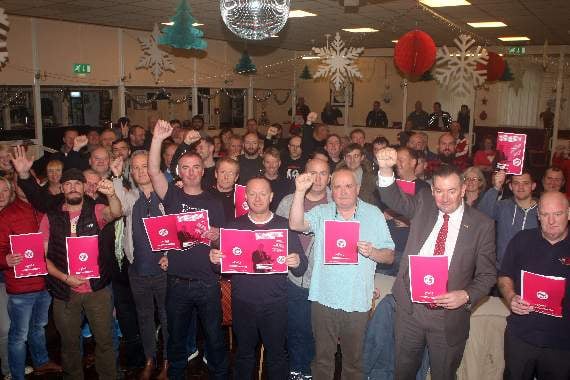
A ballot for industrial action by the island’s postal workers closes today (Tuesday) – and the result is expected this afternoon.
ome 90 to 100 members of the Communication Workers’ Union met at the Douglas Legion Club on Sunday where the mood was defiant – and there was strong support for a ‘yes’ vote.
The meeting was addressed by Terry Pullinger, deputy general secretary of the CWU’s postal section, who said members were ‘fighting for their future, the next generation and a great public service’.
Wording of the ballot seeks support for the 200 or so island members of the postal union to ‘prepare for strike action’ – although that means they could take any form of industrial action, including an overtime ban and work to rule, all the way to an actual strike.
 New organ donation law to come into force as island urged to ‘make informed choice’
 Department outlines new education priorities as Tynwald receives updated plan
.jpeg?width=209&height=140&crop=209:145,smart&quality=75) Tynwald rejects referendum on Isle of Man's Net Zero policy
Tynwald rejects referendum on Isle of Man's Net Zero policy Operating the Isle of Man’s Liverpool ferry terminal costs more than £710,000 a year
A ‘robust’ contingency plan is in place should their be a strike over the Christmas period, the Post Office board has confirmed.
In Tynwald next week, Post Office chairman Julie Edge (LibVan) will ask the court to support closing the final salary scheme for new entrants and to approve the reduction of letters delivery from six days to five days a week.
Chief Minister Howard Quayle is urging all sides to settle the dispute.
He said: ‘As an ex-president of a union I respect unions. They look after their workers – that’s their job.
‘However, it’s in the interests of everyone that Isle of Man Post Office is profitable and competitive going forward, otherwise jobs will be lost to prIvate sector companies that deliver parcels. There has to be change.
‘I do hope that workers and management can settle this satisfactorily.’
Among measures proposed is for new starters to be employed on reduced pay and terms and conditions. The CWU says this will create a two-tier service.
The board is offering a 1% pay increase for postal workers.
But the CWU says this is far lower than the pay award offered to other public sector workers.
Mr Quayle defended the proposed 55p an hour pay rise for civil servants and government manual and craft workers, saying: ‘We have to attract people to come to the Isle of Man to work.
‘The UK has taken away the public sector salary freeze.
‘The 55p per hour increase will help people on low incomes.’
Asked why the Post Office was closing its final salary scheme when civil servants and Tynwald members were keeping theirs,
Mr Quayle replied that the government scheme is unfunded and its closure would cause major cash flow issues.
In contrast, the Post Office scheme is fully funded – although it currently does have a £700,000-a-year shortfall.
Mr Quayle pointed out that teachers, police, firemen and civil servants had had to pay significant increases in the pension contributions in a move to make the schemes more sustainable in the future.
Comments
This article has no comments yet. Be the first to leave a comment.