
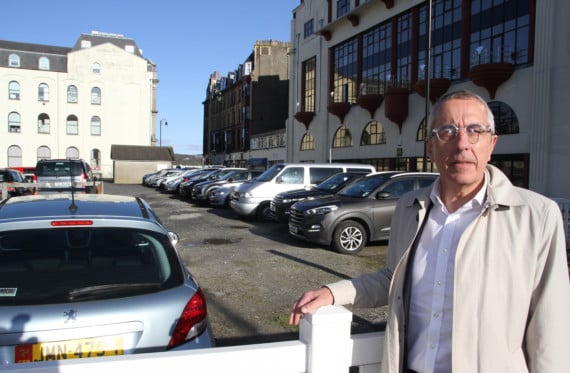
The eastern area plan could be a way to regenerate the island’s capital through the use of brownfield sites to provide new housing without the need to build on greenfield land, an MHK believes.
Middle MHK Bill Shimmins has been an outspoken critic of the area plan process, which could see greenfield sites in the east of the island - many in his constituency of Braddan, Santon and Marown - zoned for building as the government says it is necessary to grow the population.
Mr Shimmins told reporter Sam Turton about which areas in Douglas could be used and the potential boost this could have to the economy.
Providing examples such as Middlemarch, the Steam Packet car park, Lake Road by Tesco and Douglas’s South Quay, Mr Shimmins said using these sites to provide housing would boost the businesses in Douglas and improve some of the less attractive parts of the capital.

.png?width=209&height=140&crop=209:145,smart&quality=75)

He added: ’The plethora of empty sites in Douglas presents a poor picture of our island. So many have been derelict for decades. We need a change of approach.
’I sincerely hope that the Cabinet Office will get on board and drive this change rather than continuing to promote so many sites concreting over the countryside.’
During the area plan inquiry, chaired by Michael Hurley, the cabinet office alongside housing developers, argued for the zoning of several greenfield sites such as Camlork in Union Mills, Ballachrink in Onchan and Newtown near Mount Murrary for housing.
Providing examples of the Middlemarch site in Lord Street, Mr Shimmins said it provided ’prime opportunity’ for the building of flats which, like the Steam Packet car park opposite, could provide new housing rather than in the countryside.
Pointing to the recent approval by the planning committee for flats with a gym and wine bar on the South Quay next to the former Trafalgar pub, Mr Shimmins said it was a prime example of what can be done in the town centre.
He added: ’Imagine what 2,000 more people living in Douglas would do.
’It would bring the life back into the town and remove so many down-at-heel sites in our capital.’
The increase in population would lead, in Mr Shimmins’ opinion, to the capital’s bars and restaurants see an increase in footfall.
This would provide more jobs and, in turn, options for customers.
However, Mr Shimmins is not only concerned with the image some of the sites currently provide for visitors to the island.
He has also focused his opposition to zoning of greenfield sites on protecting the island’s environment.
Mr Shimmins added: ’What differentiates the Isle of Man from other similar places is our countryside. When it is built on, it is lost for ever.
’By direct contrast, our urban areas compare unfavourably with Jersey, Guernsey, Gibraltar and Singapore.
’If the eastern area plan does zone so much greenfield countryside as proposed then this will be built on in preference to brownfield.
’It is cheaper and easier to develop farmland so it makes sense for developers to choose this option.
’It does not make sense for the island as a whole to go down this route as it creates more traffic congestion and pollution while further hollowing out the towns.’
Mr Shimmins also told the Examiner that many of the brownfield sites were also owned or optioned by the same people who were proposing the greenfield sites out of town.
However, it is not only privately-held land that Mr Shimmins wants to see developed. He said he wants to see sites such as the former Victoria Road prison, Park Road school, Summerland and the Noble’s Hospital’s old nurses’ home developed, some of which have been left untouched for several years.
Using the example of the Victoria Road site, Mr Shimmins said that while it is ’great’ that the site had been made available TT visitors, he asked: ’Is that really the best use for a site that could be used for housing?’
He added: ’A strategic view needs to be taken on these publicly-owned sites to lead the way.
’A Manx Development Agency would help drive forward regeneration working with the private sector and local authorities to deliver the desired change.
’This is an exciting opportunity. We must grasp it in the eastern area plan.’
Mr Shimmins added that using such sites that fall within the captive active travel area would also be of greater benefit to building further out of town which would lead to more people commuting into Douglas, requiring more parking spaces and increasing congestion.
During the planning inquiry and in debates in Tynwald this year, Mr Shimmins has repeatedly questioned the need for the 2,400 houses in the east wanted by the Cabinet Office.
That figure is based on a population increase of 500 per year into the island.
However, the island has not recorded such an increase in the population since 2011.
And at the last census in 2016, the island’s population was recorded as having fallen from 84,497 people in the 2011 census to 83,314.
Mr Shimmins said: ’The population statistics simply do not justify the plan proposals.
’The most recent Cabinet Office statistics still show the population lower than the 2011 census.
’The eastern area plan proposals are based on population projections which are tracking at 6,500 people above reality.’
â?¢ Michael Hurley is due to present his report into the area plan to the Cabinet Office later this year or early next year ahead of the government presenting the recommendations for approval or rejection by Tynwald.
Comments
This article has no comments yet. Be the first to leave a comment.