
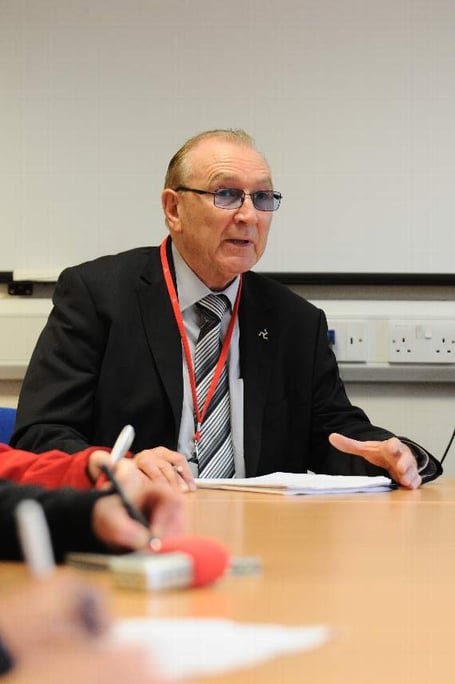
The need to have an independent chairman of the Communications Commission must be proven - says the political head of the authority.
Commission chairman Bill Malarkey, who is also the Home Affairs Minister, was speaking as MHKs passed the Communications Bill last week..
An earlier attempt to amend the bill, to make sure commission’s membership was non-political, was unsuccessful.
Last week, the bill was granted a third reading, which means it is now ready to go to the Legislative Council for further consideration.
 Building work on new Castle Rushen High School could begin next summer
 Peel Commissioners says LegCo measures will mitigate issues in local government bill
 LegCo introduce ‘safeguards’ to controversial clause five in local government bill
 Decision on Bill which could see bishop's vote end delayed until 2026
But Mr Malarkey referred to a bid to remove politicians from the commission, which was made by Daphne Caine (Garff) at the clauses stage.
Mr Malarkey said the commission was not against change but added: ’It simply wants the matter to be dealt with in an appropriate and evidence-based way.
’While there was a lot of discussion about the merits of the chair being political or not, what was not considered at all was what the most suitable structure would be.
’Any form has to be appropriate for the entire industry, not just for certain parties.’
He said the debate on the amendment had focussed on the requirements of industry.
’That, in itself, should give us all pause for thought and ask the question: have the full implications of these proposals been considered? Would it be good for the consumer? Most importantly, would it effectively result in industry regulating itself?’
Investigation
He said the issue needed further investigation.
Mr Malarkey added that a comment from Mrs Caine that the commission’s chairman should come from the industry was ’dangerous’ and would undermine the commission’s independence.
Mrs Caine said at the clauses stage it was up to MHKs to decide whether it was more important to have a ’political chair or an industry chair’.
In response to Mr Malarkey’s comment, Mrs Caine said that remark had been a ’slip of the tongue’ and that she had meant to say ’independent’, as per the aims of her amendment.
She added: ’The Communication Commission is a regulator and, most importantly, one of the aspects it regulates is the public service broadcaster.
’There is a very important principle that there should be and there should be seen to be a separation between regulator and media and also the industries.
’I cannot see why an independent chair, rather than a political chair would not be an improvement.’
This bill brings together telecommunications and broadcasting, previously dealt with separately in the Telecommunications Act 1984 and the Broadcasting Act 1993.
One amendment that was approved at the clauses stage introduces measures to make it an offence for people to send harmful messages online, aimed at covering any current loopholes in the law.
Comments
This article has no comments yet. Be the first to leave a comment.