
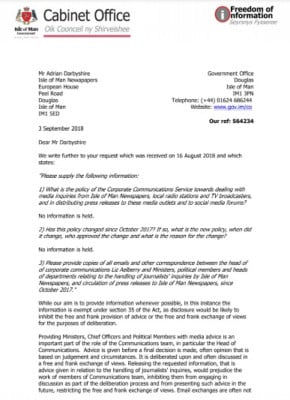
The Cabinet Office has rejected a Freedom of Information request on the government’s handling of media inquiries.
It claims to hold no information about the policy of the Corporate Communications Services on dealing with such inquiries or whether that policy has changed.
The Cabinet Office has also refused to release copies of emails and correspondence relating to the handling of journalists’ inquiries by Isle of Man Newspapers.
It cited an exemption that disclosure would be likely to inhibit the free and frank provision of advice.



-(1).jpeg?width=209&height=140&crop=209:145,smart&quality=75)
Isle of Man Newspapers has requested an internal review of the decision.
In our FoI request, we asked: ’What is the policy of the Corporate Communications Service towards dealing with media inquiries from Isle of Man Newspapers, local radio stations and TV broadcasters, and in distributing press releases to these media outlets and to social media forums?’
We also asked if this policy has changed since October 2017 - and if so, what is the new policy, when did it change, who approved the change and what is the reason for the change.
The Cabinet Office’s response was to claim that no information is held.
We also asked for copies of all emails and other correspondence between the head of corporate communications Liz Aelberry and Ministers, political members and heads of departments relating to the handling of our journalists’ inquiries, and circulation of press releases to Isle of Man Newspapers, since October 2017.
The Cabinet Office replied that disclosure would be ’likely to inhibit the free and frank provision of advice or the free and frank exchange of views’.
It added: ’Providing Ministers, chief officers and political members with media advice is an important part of the role of the communications team, in particular the head of communications.
’Advice is given before a final decision is made, often opinion that is based on judgement and circumstances. It is deliberated upon and often discussed in a free and frank exchange of views.
’Releasing the requested information would prejudice the work of members of the communications team, inhibiting them from engaging in discussion as part of the deliberation process and from presenting such advice in the future, restricting the free and frank exchange of views.
’Email exchanges are often not the final piece of work, rather the information that helps to form the same, and therefore may be open to misinterpretation.’
In our request for a review, we argue that the cited exemption is not valid. We point out that if there has been a change in policy towards the media, and the newspaper is disadvantaged as a result, we are entitled to know why.
Comments
This article has no comments yet. Be the first to leave a comment.