

Let’s follow Guernsey and Jersey’s lead and take bold steps to slim down and refocus the island’s civil service.
That’s the view of backbench MHK Chris Robertshaw who says he is frustrated at the lack of leadership and lack of progress on making vital changes to the structure of government.
States of Guernsey chief executive Paul Whitfield has written an open letter to all public service staff (copied in full at the end of this story) announcing significant changes to the top of the civil service before the end of 2018 - with the redesign resulting in the targeted removal of more than 200 posts.
Meanwhile, figures released in the House of Keys revealed the Manx government wages bill had increased by more than £2m in two years, and the number of staff directly employed has risen from 7,838 to 7,850, excluding Manx Utilities and IoM Post.

.png?width=209&height=140&crop=209:145,smart&quality=75)
.jpeg?width=209&height=140&crop=209:145,smart&quality=75)

The number of civil servants has remained fairly static since 2010, however, at about 2,200 full-time equivalent, although that figure rose from 2,207 last year to 2,247 by March this year.
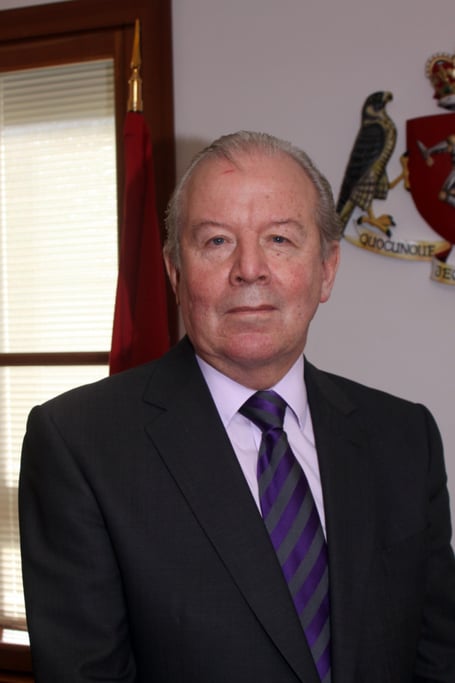
Douglas East MHK Mr Robertshaw said the open letter from the head of Guernsey’s civil service was ’extraordinarily important’.
He said while Guernsey was taking steps to ’de-layer’ its civil service and in doing so removing 200 senior posts, our government was continuing to grow ’remorselessly’.
’We are heading for difficulties,’ he warned, with a structure of government which he said is inefficient, increasingly unaffordable and draining funds from essential services.
Mr Robertshaw, who quit as the island’s Policy and Reform Minister in 2015, said: ’The elastic has snapped - I really despair. We get gestures but we don’t get action. While we were talking the talk, Guernsey and Jersey were walking the walk.
’This is not about kicking public sector workers. We need to find the money to fund frontline services. We on the other hand are protecting our old-fashioned structure and removing funding from front line services.’
He said the clarity and focus of Mr Whitfield’s letter was a ’remarkable example of bold, high quality, leadership’.
And he said this was something ’desperately’ lacking in the Isle of Man where the focus has been on Brexit at the expense of virtually everything else.
’The Chief Minister has put his head in the bucket of sand marked "Brexit" and not taken it out,’ he said. ’We are not allowed to talk about smaller, smarter government any more.’
Jersey, meanwhile, has taken a very significant move to a single unified government approach. ’It is alarming to recognise that we are being left further and further behind in the urgent need that exists to modernise how government delivers services to its citizens,’ Mr Robertshaw said.
He said it is perfectly legitimate to allocate additional staff in new areas - but not without looking to see if unnecessary roles can be removed elsewhere.
Guernsey published a 10-year framework for organisational change and transformation in 2015. Mr Whitfield said there had been successes since then. But he said: ’I have in recent months taken stock. I firmly believe that together we are ready for the next step; a step that can and should be bold.
’I have decided to make significant changes to the leadership structure at the top of the civil service before the end of 2018.’
Guernsey’s new leadership team will group strategic responsibility by services and customer need. It will comprise of six roles, rather than the 13 at present.
BACKGROUND:
The size of the Manx public sector has been subject to two major reviews, the Scope and Structure of Government report in 2006 and a follow-up in 2012.
Between those reports, the government suffered a huge blow.
The UK clawed back money from the island as it redrew the terms of the VAT-sharing agreement in two stages, in 2009 and 2011.
The upshot was that the Manx government lost about a third of its income.
Politicians united in saying that the island had to make radical cuts.
Indeed, in the 2013 budget, the Treasury Minister announced that the headcount should be cut by 300 posts over the next three years, adding to the 400 posts and 300 staff lost since 2010.
The reality is that headcount is much the same as it was in 2010.
In 2012, a review of the 2006 Scope of Government report was conducted by a panel led by former Clerk of Tynwald Robert Quayle and others, including the island’s first Chief Minister Miles Walker.
That concluded that change was more pressing than in 2006 and the panel was disappointed that there had been no radical change.
The recommendations included using outside agencies to deliver public services - 'privatisation lite'.
Among the services suggested were the airport, the Post Office and the bus service.
They also said that local government should be reformed - with the number of authorities being cut but each authority being bigger - and they should take on some more responsibilities from central government.
They also wanted expert external reviews of service provision and a reform of redundancy policy to make it cheaper to cut public sector staff.
Mr Robertshaw is a former Minister for Policy and Reform.
He quit that role in February 2015 because he said that he couldn’t make the headway he wanted. He is no longer a member of any department of government.
Read the Isle of Man Examiner’s editorial comment on this subject in this week’s paper, which is on sale now.
Mr Whitfield’s full letter:
States of Guernsey Chief Executive Paul Whitfield has published an open letter to public sector colleagues outlining plans for the fundamental redesign of the civil service.
Dear colleagues
When appointed as Chief Executive five years ago, I was given a clear brief to develop and deliver a programme of Public Service Reform that would improve the way we delivered services to our customers.
I took a deliberate decision that we would pursue incremental change and transformation rather than taking a big bang approach. It was important that we researched and prepared ourselves for any further large scale initiatives.
In 2015 we published a 10-year framework for organisational change and transformation. We wanted to achieve the following:
Make the services that we provide customer-focused - that is, easy and flexible to access, with a single point of contact, and with assurance that the services will be of a consistent quality
Delivering and demonstrating value for money - a reduction in the cost of government will allow us to reinvest in front-line services
Create a more effective and efficient public service, with strong governance and clear accountability to best support the political body
We have had many successes. We have efficiently implemented changes to the machinery of government; we have moved hundreds of staff in a short space of time when vacating Grange Road House and Cornet Street; we have created a joint counter service for customers at Edward T Wheadon House; we have introduced the new income support scheme which is also supported by digital enhancement; we have implemented the new population management regime; we have introduced the Customer Charter to help us improve service; and we have brought rigour and control to our spending. These are but a few examples, and each one of them has brought positive change.
Less tangible, but equally important, is the discernible cultural change that has taken place. I have no doubt that as a public service we have come together and recognised the challenges we face as one organisation, in both the short and long-term. That realisation has made us stronger.
Looking ahead we are progressing massive transformation programmes in both Health & Social Care and Education. Likewise we are making much needed investment in our ICT, with the Future Digital Services programme recognising the vital role technology plays in our efficiency, and later this month we will be launching the Revenue Service (combining Income Tax and Social Security Contributions).
I have in recent months taken stock, looked at how far we have come and how far we have to go. I want to take this opportunity to thank each and every one of you for getting us to this point, where I firmly believe that together we are ready for the next step; a step that can and should be bold.
As we have progressed Public Service Reform we have made a number of changes to our structure. However, it has become very clear that the constraints of the current structure of the civil service are not going to allow us to effectively reach our organisational goals and support the government’s aims.
Historically our civil service structure has reflected political structure, but that does not help us to work across services and it does not play to our strengths. If we want to demonstrate a similar approach to achieving efficiencies as we have seen across many public and private sector organisations, then we need to be able to take a similar approach to organising our resources. We must do this without compromising the support given to committees. We need to be structured in a way that is more efficient, that removes the silos that still exist despite our success to date, and that allows us to truly work as one organisation - all of which will help us better serve the public, which is our absolute focus.
As such, I have decided to make significant changes to the leadership structure at the top of the civil service before the end of 2018.
The new leadership team
The new structure will group strategic responsibility by services and customer need across government. This will join up services at the highest level and in turn provide greater support for committees from strategic leaders freed up from operational responsibility. In addition there will be senior operational leads for each committee with additional specific officer support to ensure the effective running of committee business.
The new civil service leadership team will comprise of six roles, rather than the 13 at present (please note the list of responsibilities is illustrative and not exhaustive):
The Chief Executive;
Strategic Lead for Supporting Government - including responsibility for legislation, cross-government policy development, committee support, government business, external relations;
Strategic Lead for Finance & Investment - including the financial strategy, the Revenue Service, all Treasury functions including the fiscal framework and tax policy, the capital portfolio;
Strategic Lead for People Policies - including responsibility for policy development and implementation on areas such as children’s services, adult services, public health, education and lifelong learning, inclusion and equality, employment, social security benefits and social housing;
Strategic Lead for Place Policies - economy and productivity, planning and development, regulation, transport, infrastructure, environment services, energy, justice; and
Strategic Lead for Delivery & Support Services - Operations, HR, digital and information services, procurement, property and facilities.
In addition, I will oversee seven States-wide support services which will underpin transformation activities: change and transformation; communications; workforce/ organisational design; customer experience; data and performance; compliance and assurance; and a portfolio office.
Supporting the Committees
In terms of supporting committees, the new leadership structure will further develop and enhance the civil service’s ability to offer quality objective advice.
The traditional role of Chief Secretary will be removed, and support for Principal Committees will be strengthened in the following ways:
The Strategic Lead for People Policy will provide high-level cross-committee policy advice and support for the Committee for Health & Social Care, Committee for Education, Sport & Culture and the Committee for Employment & Social Security
The Strategic Lead for Place Policy will provide high-level cross-committee policy advice and support for the Committee for Economic Development, Committee for Home Affairs and the Committee for the Environment & Infrastructure
A committee secretary, with responsibility for day-to-day business and governance
A specific and accountable operational lead(s)
This combination of roles, with clear lines of accountability, will ensure committees receive excellent well-rounded support from the senior civil service, while joining up the lead and development of strategy and policy across government.
Fundamental redesign of the civil service
Once the new leadership team is in place by the end of this year, they will lead and implement (by the end of 2020) a fundamental redesign of the entire civil service. This will be supported by the two related activities of:
the delayering of the civil service and reduction in the number of senior civil servants
the redesign of all processes and services which will involve digitising services and a reduction in the number of more junior posts.
This redesign will result in the targeted removal of more than 200 civil service posts - it is important to emphasise this specific programme does not include teachers, nurses, law enforcement officers, social workers or other public sector workers.
It is crucial, and I cannot stress this enough, to understand that the sustainable reduction of civil service posts will not be achieved by simply doing what we do today but with fewer people. To achieve this we must and will:
fundamentally change the way we think about services and how we deliver them;
break down the barriers and silos that exist in our current organisational structure;
redesign our services to focus on what it is service users are trying to access, and enabling them to do so as easily and painlessly as possible; and
take services on-line wherever it is practical to do so, and automate as many of the processes needed to deliver them as possible.
Significant financial benefits will be delivered over the two year period of 2019-2020, estimated to be in the range of at least £10m per annum recurring once all changes have been implemented. These figures could increase as the redesign progresses.
The 2019 Budget contains a recommendation to release initial funding of £8m to run the civil service redesign programme, including a targeted voluntary redundancy scheme. Again and for absolute clarity, this will be voluntary at this stage.
It is important for all colleagues to understand from the outset that staff will only be considered for targeted voluntary redundancy if roles can be removed as a result of a service doing things differently. Our goal is not to simply cut staff, or let colleagues go when they are providing a critical role. This is about redesigning our civil service to better serve our customers, and identifying roles we no longer need as part of a targeted voluntary redundancy programme.
I hope that many of you will see this as a challenge that you want to be part of, and as an opportunity - and there will be opportunities within the new structure. The next 18 months will be a period of significant and exciting change. I know, however, that there will be some who won’t feel that they want to be part of this change. We will provide further information about the targeted voluntary redundancy programme as soon as we can. This may not be until the New Year given it is reliant on us appointing the senior leadership team and that team completing initial work on the fundamental redesign of the civil service.
Whenever I have been asked about staff numbers and staff costs, my response has always been the same - it’s important that the States of Guernsey has no more or less staff than we need. We currently have in the region of 1,600 civil servants. A reduction of more than 200 posts is significant, but achievable. We know that Guernsey currently has many vacancies in the private sector, and we’ll be releasing skilled staffed into the island’s workforce. If we do this the right way - by truly redesigning how we deliver services, by maximising technology and by delayering the senior civil service - then the benefits will be felt by us, by our customers, in the public purse, by the political body and by the wider economy.
I am under no illusions that this is a significant programme of change. I am, however, absolutely confident that it will be delivered. I thank you for taking the time to read this letter, which given the public interest I will be publishing as an open letter tomorrow. I wanted you all to hear directly from me first.
I give you my commitment that I will communicate with you regularly as this programme progresses.
Paul Whitfield
Chief Executive, States of Guernsey
Comments
This article has no comments yet. Be the first to leave a comment.