

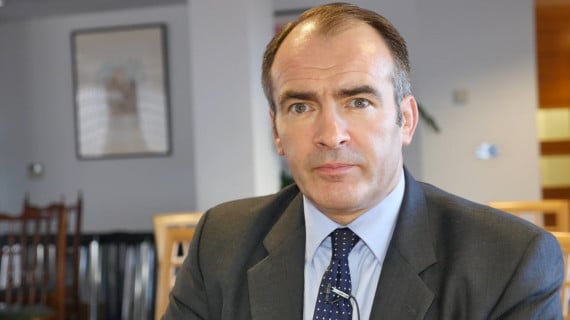
Whatever happened to the idea of ’smaller government’?
Treasury Minister Alfred Cannan revealed before a Tynwald scrutiny committee that the number of government staff has grown, partly as a result of Brexit and other international pressures.
And he admitted that the government’s SAVE programme had ’not been a wholesale success’, achieving far fewer savings that initially hoped.
Economic policy review committee chairman Chris Robertshaw accused him of being an ’apologist for expansion’.
 New organ donation law to come into force as island urged to ‘make informed choice’
 Department outlines new education priorities as Tynwald receives updated plan
.jpeg?width=209&height=140&crop=209:145,smart&quality=75) Tynwald rejects referendum on Isle of Man's Net Zero policy
Tynwald rejects referendum on Isle of Man's Net Zero policy Operating the Isle of Man’s Liverpool ferry terminal costs more than £710,000 a year
Mr Robertshaw said: ’There is perhaps a sense out there that government just keeps growing.
’The last administration was very much up against it in a very visceral sense. Personally I feel that a sense of relaxation is starting to occur that "oh, the worse is over".’
Mr Cannan said it was a ’difficult battle’. He pointed out there was a ’very ambitious’ Programme for Government and significant demands, particularly on front line services.
For example, the police force was growing in numbers and the health service was having to employ quite a number of interim or temporary staff to cover full time roles and shortfalls.
Mr Cannan said: ’And of course we have not only Brexit for example - that has helped grow numbers although people have been brought in on one or two-year terms - there’s demands made on us by our commitments to MoneyVal, EU blacklisting and recommendations we are signing up to. You will see an increase in numbers there.’
There was also the strengthening of the island’s financial crime capability and also pressure over the aircraft VAT issue where extra resources had to be brought in.
’We have to adopt a much clearer strategy if we are going to control our personnel numbers,’ added the Minister.
Mr Robertshaw replied: ’I don’t see that clear strategy. It’s almost as if , since this administration started, "smaller government" has become a bit of a swear word.’
Latest figures, provided to the committee, show that in 2018-19 there are 7,390 full time equivalent staff in post across the island’s public service.
This is a fall of 76 on the previous year figure of 7,466 but the number has risen by 111 since 2015, although government employs 439 fewer full time equivalent staff than it did in 2011.
The figure had fallen from 7,829 in 2011 to 7,279 in 2015 but had risen steadily since then.
The total pay bill, including overtime and allowances but excluding agency staff, has increased from £298.7m in 2013-14 to £344.8m in 2017-18, according to latest government accounts.
Mr Cannan admitted the SAVE programme had ’not been a wholesale success’. He said he had set out in the Budget the need to find savings as there was still £15m unaccounted for.
But he said, in the best case scenario, the SAVE programme might secure savings of £5m to £6m but this was ’significantly less from where we first started’.
He insisted it was still a worthwhile project not only in financial terms but also better service delivery and provision.
Mr Cannan said there were three key projects on stream with clear savings attached.
The legal aid review is predicted to save £1m but the Minister said it remained to be seen whether this would be achieved. There is also higher education consolidation and Mr Cannan said a bus and rail strategy has delivered £1m of savings.
Two or three other projects are still in assessment stage.
Comments
This article has no comments yet. Be the first to leave a comment.