

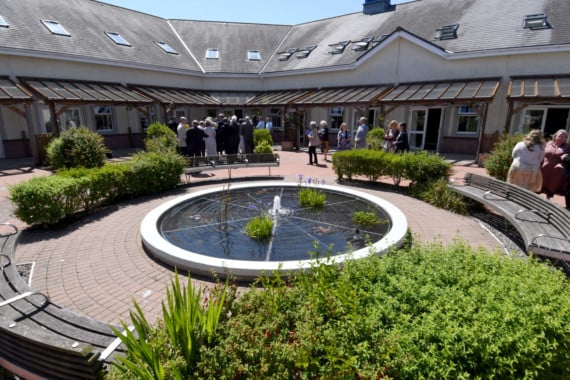
The Hospice building near Noble’s Hospital has officially reopened following a £3.5 million refurbishment project.
The in-patient wing has been named the Tevir Centre, after a £2.5million donation which from the investment management firm.
The building has capacity for a total of ten patients, and it also now includes two rooms which have been turned into assisted living suites.
These mean that patients who are struggling at home can be brought in for assessment and assistance with mobility, or they can be offered to patients who are on their way back home, to help them transition from hospice care back to normal life.
.jpeg?width=209&height=140&crop=209:145,smart&quality=75)

This can help prevent readmission, by ensuring that patients are ready to go back home.
At the ceremony Lieutenant Governor Sir Richard Gozney, before unveiling a plaque, read out a letter of congratulations sent by Princess Anne, as she had opened the original building in 2008.
It read: ’I would like to offer my congratulations on the successful refurbishment of the Hospice Isle of Man building and facilitiesâ?¦
’With the support of a range of local sponsors and an expert project team, you have achieved a wonderful result - with well adapted and updated facilities for patients, their families and friends, staff members and volunteers.
’The emphasis on greater independence, privacy and dignity for those receiving palliative care and for those, sadly, at the end of their lives, provides much needed support and solace for all.’
Also in attendance were Chief Minister Howard Quayle and Douglas Mayor Jon Joughin.
The extensive project was originally scheduled to be several modular building improvements carried out over a five year period, with patients being looked after in the Southlands nursing home in Port Erin while the Hospice building was shut.
The renovations had been due to be completed in May, but the pandemic caused a delay until December.
The charity described the original building as ’serving its purpose very well’ from 2008 to 2019, but cited both forthcoming planned changes to disability regulations and also the changing needs of patients as being reasons for the refurbishment.
The Hospice now has new bedrooms, a children’s area and larger ’dream room’ (or sensory play area) which is more accessible to patients in beds, new in-patient reception doors, therapy spaces, apartments for families, a canopy over the in-patient entrance and patio doors in some bedrooms to access the garden, which has a fountain feature as its centrepiece.
The refurbished Rebecca House (children’s) wing also features a soft, rubber-surfaced outdoor play area with a swing and wheelchair-accessible roundabout.
Nine-year old Dylan Walton, who has cerebral palsy, had helped raised money for the playground by completing challenges like climbing Snaefell.
Hospice spokesperson Stephanie Gaines described the old building as being ’not fit for purpose’ and ’old fashioned’ and said the new facility felt ’less clinical’, as well as having purpose-built beds.
In all the refurbished areas, from the Rebecca House wing to the new reception lounge, the colours are all now much brighter, and the interior airier and more modern-looking.
Staff nurse Beth Vickers said: ’For me personally I think this is a very bright, happy place.
’I think it’s very important for it to be a home away from home [for the patients], and not so much a clinical scary setting, particularly for the children. We do a lot of respite care for children, just to give the parents a little break.
’There’s so many facilities, toys, and arts and crafts - there’s so much for the kids to do.
’They love coming here, so it kind of takes away the stigma of the Hospice - though obviously it is for end of life care as well, and that is an aspect of our job.’
There is also the dedicated ’rainbow room’ which serves as a place of rest for children who have passed away, before the funeral - as an alternative to a funeral parlour.
Ms Vickers pointed out that this room is available for any family who has lost a child in the island, not just patients of Rebecca House.
Hospice Isle of Man chief executive Anne Mills said: ’When the first patient came through the doors she was blown away, and her family that came with her, they just absolutely loved the way we’d brightened all the colours, the kind of facilities there were, and how easy it was for her to have showers - to keep her dignity and privacy.
’And the staff love it as well.’
Asked how future-proofed the new facility is and how long it would serve its, Mrs Mills said: ’We [The Isle of Man Hospice] opened up to non-cancer patients in 2016, [and] it was quite clear that [with] the profile of our patients - the building didn’t suit their needs.
’So this will keep us going for 25-30 years.
’Obviously there will be capital planning and a few minor refurbishments, but this is an exceptional facility and it probably is one of the best hospices in the UK.’
Asked about whether, like other charities, the Hospice had experienced a drop in donations during the pandemic, she confirmed it had, saying: ’Retail [charity shops] flatlines every time you have a lockdown.
’You’re not able to hold events, so donations have flatlined.
’And for some reason legacies (donations from wills) are not coming in either, so we’re never complacent.
This wonderful donation from the Tevir Group was for this specific purpose [the refurbishment], but running costs are always there - which are around £5.5 million [annually] at the moment.’
When it was pointed out that the service may see more demand in the future considering the island’s aging population, she said: ’Yes, we’re a hyper-aged society here - so there’s more over 85s here than you find in maybe, Greater Manchester or somewhere like that.
’So the numbers that you need to plan for in the future means we need a really good facility, but you also need a hospice at home team as well, to look after people at home for as long as possible rather before they come in, rather than having long stays here.’
Comments
This article has no comments yet. Be the first to leave a comment.