
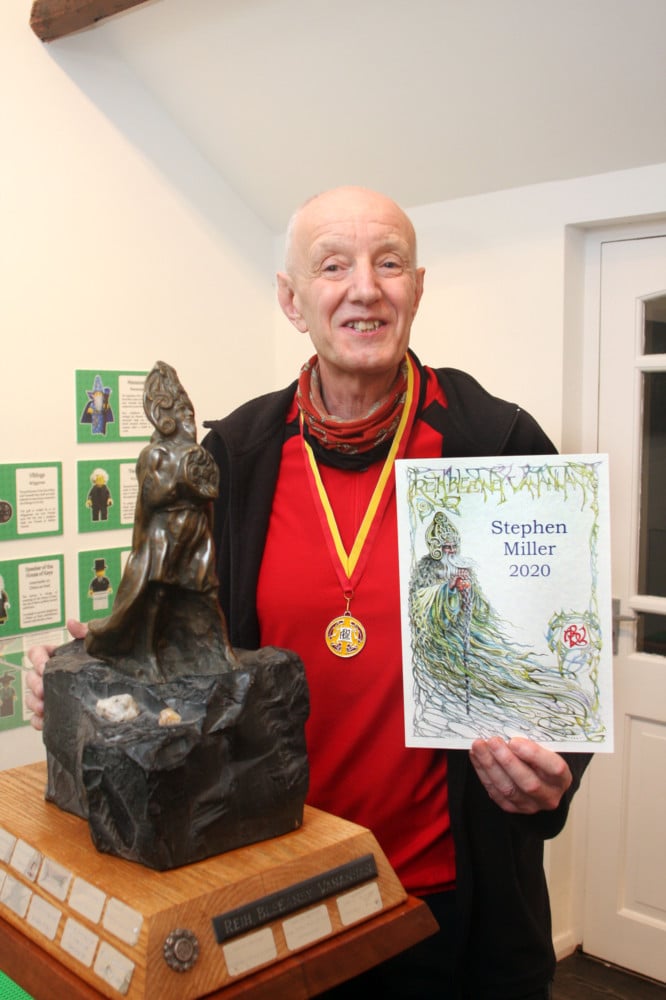
One man’s lifelong interest in re-telling old stories and folk tales of the Isle of Man has led him to be named the recipient of a major cultural honour.
Researcher and writer Stephen Miller was awarded the Reih Bleeaney Vanannan for 2020.
The award which, translated from Manx Gaelic, means Manannan’s Cultural Choice, was bestowed on Stephen at a ceremony held at the offices of Culture Vannin on Friday.
He was presented with the trophy, a representation of the Manx god Manannan, by Chris Thomas MHK, the chair of Culture Vannin, who also presented him with a medal and hand-painted certificate.
-(2).jpeg?width=209&height=140&crop=209:145,smart&quality=75)

.jpeg?width=209&height=140&crop=209:145,smart&quality=75)
-(1).jpeg?width=209&height=140&crop=209:145,smart&quality=75)
Stephen was named as this year’s recipient of the RBV award due to his largely self-motivated work researching Manx folklore, song, and folk dance, as well as studying and understanding the key figures and folk collectors involved with the Celtic revival, such as Edward Faragher, Karl Roeder and Eric Cregeen.
A noted historian and lecturer in folk studies, Stephen, who was born and grew up on the island, but now lives away, has devoted much of his time to searching through the archives of the Manx Museum and interviewing and collecting his own source material from around the island, transcribing and re-publishing several books, such as William Cashen’s ’Manx Folk-Lore’ and John Rhys’s ’Manx Folklore and Superstitions’, along with his most recent release, Karl Roeder’s ’Manx Notes & Queries: Ghosts, Bugganes & Fairy Pigs’, which was published last year.
He also regularly published his works on his ’Chiollagh Books’ website, the ’Kiaull Manninagh Jiu’ Newsletter and in the Ballaugh Heritage Trust newsletter,
He has a particular fascination for the contents of the Manx Folklife Survey, a collection of folk-memories, recollections and stories which began in 1938.
Stephen said that he thinks the stories and information contained there provide an invaluable link to the history of the Isle of Man, and that he was keen to make sure as much of it was made accessible as possible.
’These stories should be read, enjoyed and understood today,’ said Stephen. ’The detail that is in the Manx Folklife Survey is remarkable.
’Every time you read something, you find a place name or a nickname for somewhere, or a fishing practice or whatever, that has now gone.
’When you look out over the northern plain, nowadays, what you don’t see are the little cottages, made of sods that once dotted the land. ’The small-holders, crofters and the people who lived and worked there have all gone.
’The memories in the Folklife Survey reveal the individuals who lived in this field, or who worked where, together with such activities as the illegal distilling of whiskey.
’We can’t actually ask these people anymore, but their stories are still there.’
’I must have spoken to and interviewed nearly 50 people about their lives and their reminiscences on the island,’ he said.
’One man I spoke to, many years ago now, called Alfred Tate, was one of the last Manx men who went fishing mackerel in Kinsale, in 1912. When I asked him how he could be so sure of the year, he answered that he saw the Titanic sailing past.
’What lives did these people lead, and what happened to them?
’These are the things I want to ask and they are also the questions that I enjoy answering.
’It is a fantastic thing for me to have been acknowledged for what I enjoy doing.’
by Mike Wade
Twitter:@iomnewspapers
Comments
This article has no comments yet. Be the first to leave a comment.