
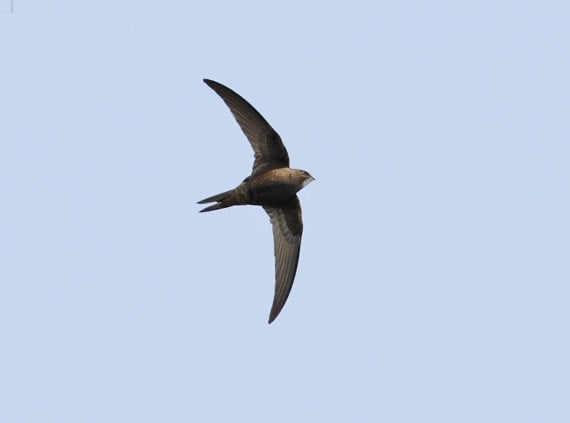
The decline in the number of swifts in Manx skies is concerning bird watchers.
Now Manx BirdLife and the Manx Ornithological Society are working together to gather information about the Isle of Man’s swift population.
The so-called common swift apus apus is officially common no more. It is in serious decline.
Since 1995, the swift population has declined across the British Isles by nearly half.



Ornithologists on the island can recall seeing large flocks of wheeling swifts in spring and autumn, with good numbers breeding in the towns, including Ramsey, Douglas, Castletown, Peel, Port Erin and Port St Mary.
Today, the swift is a rare breeder and numbers observed migrating, for example over the Calf of Man, have become progressively fewer.
Such is the concern that following the latest official review of the status of birds in the UK, Channel Islands and Isle of Man, the swift was raised to ’amber’ in the resulting list of Birds of Conservation Concern.
While the swift has suffered a steady and prolonged decline, 2019 has seen a particularly sharp drop in the numbers - and not just of swifts, but of swallows and house martins too.
Storms in North Africa during the spring migration period and wet, cold weather in southern Europe, plus a particularly cold and wet May across the UK and Isle of Man, caused swifts to arrive two weeks late.
Although swallows and house martins arrived broadly on time, reports reveal a great reduction in their breeding numbers this year.
As well as climate change, increasingly erratic weather and the well-reported reduction in insects, the loss of nesting sites has also been a factor in the swift’s decline.
Modern, tightly-constructed buildings, for example with plastic sofits and fascias, simply do not offer the same nooks and crannies in which swifts can nest.
This is a significant problem for a species that originally nested in trees, but over centuries changed its habits to nest in man-made structures.
The Manx Ornithological Society and Manx BirdLife have a project to boost the number of swift nest sites by installing specialised nest boxes and nest bricks.
Over the past two years, they have been asking people to report sightings of swifts and their nest sites.
Swifts like to nest colonially in the same area, so any information about where they nest will help to identify the best places where boxes should be installed.
Swifts lead amazing lives:
·They eat, drink, preen, sleep and mate while flying 500 or miles a day;
·Their migration to Europe from Africa in early May and back again at the beginning of August involves a round trip of 14,000 miles;
·A pair will remain together for their whole lives of up to 30 years - during which time each bird will have flown more than two million miles.
They nest in small holes in the eaves, gables or upper walls of buildings, feeding only on insects and spiders that they catch on the wing.
For more than 2,000 years they have nested in buildings, but refurbishment of older buildings and modern building techniques offer few nesting opportunities.
Swift nest sites are difficult to find as, unlike swallows and house martins, the nest is not visible and the birds leave little trace of their presence.
The best time to find nest sites is when the birds are flying low over buildings and dart into the nest hole to feed young.
On fledging, young birds leave the nest and stay airborne for two or three years.
In the year before they will first breed, they return to the summer nesting grounds to check out possible nest sites for the next year’s - and their first - breeding season.
They can be seen flying up to possible sites to take a look, where they will bang their wings against the bricks and walls. This behaviour gives rise to their nickname of ’bangers’.
Already, the MOS and Manx BirdLife have installed nest boxes in the towers of both St Ninian’s and St Thomas’ Churches in Douglas, at St Catherine’s in Port Erin and on Castletown town hall.
But many more are needed.
The organisations want people who spot swifts to report them at www.manxbirdlife.im/manx-birds/action-for-swifts.
They’d also like people to consider providing a home for swifts.
Swift next boxes and nest bricks are easy to install.
Comments
This article has no comments yet. Be the first to leave a comment.