
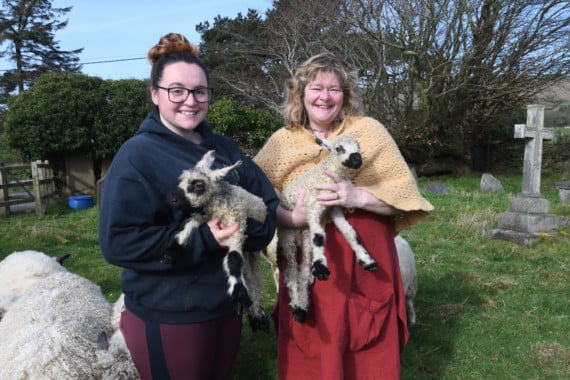
Meet Sara Hogg - she’s on a mission to get more people appreciating the joys and possibilities of wool, and more farmers in the island rearing ’fibre flocks’.
’It’s the most amazing stuff: it grows on our sheep, they willingly give it to us. Let’s delight in what’s there,’ says Sara.
She is passionate about wool and about encouraging more farmers in the island to gain value for their fleeces. She would love to keep a ’fibre flock’ herself but says it’s not easy to find the right land to rent: anything with lots of brambles, for instance, is a no-no because of the damage they do to a fleece as the sheep brushes past.
As it is she has a small flock of 27 sheep, 19 of which are Teeswaters: ’My favourite wool in the entire world is Teeswater: it is so soft. It’s the most exquisite fibre because it reflects the light and it has the most beautiful drape when you wear it.’
.jpeg?width=209&height=140&crop=209:145,smart&quality=75)
When she shows me a hank of it I realise she’s right: it feels exactly like cashmere. This would sell for £18 a hank. ’That’s a fair price for it,’ she says.
As she goes on to explain, it’s quite a process to get it from the sheep’s back to something you would knit with: ’Turning fibre from the sheep into wool is very expensive.
’You have to get it off-island to a processing mill; you have to get it cleaned; you have to get it scoured. Then it has to be processed and then you have to get it back on island.’
Sara began this process with her own flock and some Zwartble and Blue-faced Leicester fleeces she gathers from farmers she knows in the west of the island.
She has a lot of willing help from Rachael Harrop who is her shepherdess.
Adding in the year it takes for the sheep to grow the wool, and the time it takes for Sara to spin the wool when it comes back to the island, the whole process has probably taken three years but now she has started to get her wool into the shops under the brand name Willing Hearts. You can find it at the new Close Leece farm shop.
Sara was taught to knit and crochet at a very young age by her nan and she went on to teach her own five children.
Her husband Richard is a consultant surgeon and his job has taken them all over England.
Sara says: ’Whenever we arrived somewhere, we had to find "the woolly people". His first consultancy was in Cumbria and so the first weekend we went to Caldbeck, to Priest’s Mill and there was a wool place there called the Woolclip.
’It was a co-operative of wool workers and at that point I understood a little bit about wool - I’d knitted and I’d learned to spin a little bit, I knew what was good fibre and what was bad fibre. My time with them served as an apprenticeship, where they shared their knowledge willingly.
’They were set up when foot and mouth happened. Overnight they had nothing for their sheep meat, so they had to make something of their wool and that’s how it began.
’They hold an annual festival in Cockermouth, called Woolfest, which now attracts thousands of people.’
Richard is from the island, he was born in Santon, and it was always the plan that they would come and live here one day. Eight years ago a job became available at Noble’s and they moved over here, to a house just outside Peel.
Since she arrived it’s fair to say that Sara has shaken up the ’woolly people’ here: among her accomplishments a few years ago was ’yarn bombing’ Peel, a feat which included turning one of the lighthouses into a woolly Dalek.
She also got together a group of like-minded people who are creative with wool. They call themselves Fibrespace and together they made a series of panels describing ’wool life’ in the island, from ancient times to modern, which they took to display at Woolfest ’to show the world what the Isle of Man can do with wool’.
Sara says: ’There is a big wool story here and I’m just a tiny part of it. We have amazing grass so the sheep get good quality food which means the wool they produce is good quality.
’We also have the most incredibly creative nation like I’ve never known anywhere else. You are literally falling over creative people here.’
Now she would like to see more farmers rearing sheep for wool.
She says: ’There are farmers here that, if they knew how, could command a better price for their wool. I think the process of what I do is unfamiliar to people and it’s not an easy process to do. I appreciate that, for a farmer to add this to their list of jobs to do might not be what they need!
’But I would love to see a marketplace for Manx wool.’
And she goes on: ’There now is more shepherding for wool and people are understanding that how you treat the sheep is everything if you want a high yield of good quality wool.
’[For instance] I’m pretty sure that most people don’t understand that when you give an animal antibiotics I can see it in the wool. I can take off the fleece and I can say: ’Oh look, three months ago that animal was poorly.
’And what means is that, when it goes through the processing, from where it was sick to where it was growing drops off and can’t be used so that then becomes waste.
’So if I send a 5kg fleece in by the time it’s scoured, if it’s not been treated well the loss is more than 50% and you pay on the amount that goes in not on the amount that comes out of the mill.
’And one of the biggest things is the use of coloured spray, to use it carefully and not too thickly otherwise it won’t wash out and I can’t use the wool. The simple solution is to spray the head or back legs.’
Among the people who like to get creative with their wool there is a growing interest in where it has come from, just the same as with meat and other animal products.
Sara says: ’The thing that’s beginning to get interesting is provenance and I can take you to the field where my wool has come from.’
And she adds that she is more than happy to advise any farmers who want to add value to their sheep’s wool.
Sara herself is very grateful to Nigel Kewley and Brian Leece who willingly shared their knowledge and experience  on shepherding, and says: ’I in turn am always happy to pass on any knowledge that I might have and my delight in the wool process’.
â?¢ Where to buy Manx wool and wool products: -
Jenny Shepherd and Rawdon Hayne keep a flock of around 900 Manx Loaghtans at Ballacosnahan Farm, in Patrick. They sell their wool, knitting kits and wool products online at www.manxloaghtanproduce.com.
Laxey Woollen Mills makes a range of products using traditional weaving methods. They sell Manx Loaghtan wool and a variety of Manx wool products, www.laxeywoollenmills.com.
Glen Moore Cottage Retreats in Sulby are hosting Willingheart and Fibrespace for the Isle of Man Art Festival, May 4-6. There you can discover all about wool processing and see the Fibrespace wool art panels that were displayed at Woolfest last year.
Comments
This article has no comments yet. Be the first to leave a comment.