
Never give up, no matter what the odds because you just never know what you are capable of. If I can return from a hopeless situation then so can anybody.
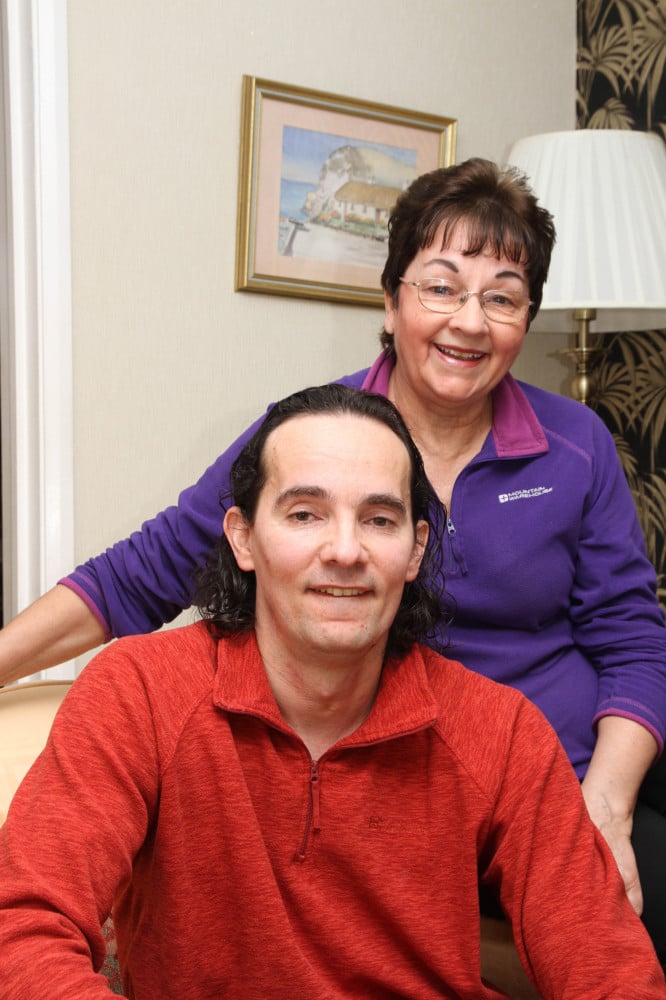
Shaun Wilde was in the most ’hopeless situation’ imaginable, writes Mel Wright.
At 40, a major stroke left him completely paralysed.
Dead but still alive, he had ’locked in’ syndrome, in which he was trapped in an entirely frozen body.
.jpeg?width=209&height=140&crop=209:145,smart&quality=75)
.png?width=209&height=140&crop=209:145,smart&quality=75)
Unable to move, talk, eat or drink, but still conscious and able to think, his only form of communication was through blinking.
Locked in syndrome affects around 1% of people who have a stroke. There is no treatment or cure and it is extremely rare for patients to recover any significant motor functions. About 90% die within four months.
Shaun, of Ballabeg, is one of 15 people in the world to have recovered and today he is walking, talking, joking and even working.
The nightmare began on August 23, 2015. He said it came out of the blue one ordinary day.
’When I woke up in the morning I felt a bit sick, light headed, not very well. I went for a walk to clear my head. I didn’t think for one minute it was the beginning of a stroke,’ he said.
’I went to Mum’s to watch football on television. But I wasn’t getting any better. She said she was not sure about it so we called the paramedics and they said they’d like to take me to hospital.
’It’s a bit surreal. You hear and read about it, but don’t think it will happen to you. I remember the journey into hospital, but shortly after things are unclear for a week to 10 days. It’s intermittent, I was in a dream-like state. It’s hard for me to put a date on anything, I had no idea of the time or day.
’I guess it was two weeks before I came round.
’Was I aware? Yes and no. It’s surreal. I was too tired to care about anything. It sounds daft saying that, but I just wanted to sleep. I thought: "Don’t worry about me". I lost everything: movement, speech.
’They’re the main things. I was not upset. It was frustrating. You take it for granted, asking for things saying things, taking part in conversation.’
He communicated through blinking, then he progressed to use a letter board, looking at letters on a board and spelling out sentences. He was tube-fed and immobile for months and months.
At Noble’s Hospital, he needed head supports but said these made him feel more trapped.
’When you had to get out of bed you’d be hoisted out,’ he said.
’Looking back it had to be done, that was the only way of moving people. If I wanted to move if the hoist was not free I had to wait and sitting in the wheelchair would be uncomfortable for me.’
Then slowly, in early November, things began to change.
’My speech started to come back,’ Shaun said.
’I got some degree of movement in my toes and hands and legs to a point. It was all very limited.
’You try to move your hands, staring at them for minutes.’
Does he remember what it felt like? ’Yes and no. I was made up, pleased but that was frustrating. You want to be able to move. There were weeks of doing nothing. If it sounds boring, it was. Time didn’t drag, I was always wanting to make more progress.’
In December that year he was transferred to Walton Hospital, in Liverpool.
The medical staff didn’t talk about his likely prospects. ’They never said anything, they can say what they think but not for definite which suited me. I would rather that, do my own thing and see how it goes.’
Days were filled with a schedule of rehabilitation involving physio, occupational and speech therapy.
His weight dropped to eight stone, from 11 stone before the stroke.
He was fed by a tube up his nose for eight weeks then a peg tube into his stomach.
’It was difficult at the beginning not to eat or drink, the hardest thing was not to drink,’ Shaun said.
’My mouth got very dry. Later on I was allowed to soak a sponge in cranberry juice. It was no substitute but was better than nothing.’
He said he missed drinking more than eating.
The first thing he ate was birthday cake.
’People say the best cup of tea in the morning is the first one,’ he said with a smile.
’You get to the point you’re not bothered about eating after the first two or threemonths you go cold turkey.’
He was discharged and returned to the island in June 2016.
’It was a bit strange,’ he said. ’It was good to see places and people. There is no substitute for seeing people.’
Extraordinarily, he returned to work as a company administrator at Crowe Morgan in October 2016. He works two and a half days a week and his focus is firmly set on recovery.
’I used to do yoga, football and cycling. That level of physical fitness helps considerably with rehabilitation. It is frustrating, boring and very samey. It’s another day, week, month, another chance to recover. You’ve got to be patient.’
He goes to the gym three mornings a week and uses the treadmill and cross trainer. He also does physio at home and has acupuncture to boost his energy.
’Over the course of months I improve. When I get wound up my speech is worse. You’ve got to learn to deal with it.
’I wake up and think I’m glad I can move. Physically I’m fine. Mentally you get into a certain way of thinking that affects the way you look at it, you’ve got to adjust and hope it gets better.
’I started in a wheelchair, then moved to two crutches, two sticks, one crutch, now a walking stick.
’I know I’m making progress. I appreciate things that people take for granted: walking, talking, the basic things. I don’t mean that in a nasty wayâ?¦you only notice when you can’t.
’Psychologically you can be affected more than you realise. When it happened I was probably in a state of shock, it’s bound to affect you.
’I’m trying to write a book. I’m lucky it did give me the chance to get out, it sounds daft saying I feel lucky, but sometimes you do.’
He added: ’ Obviously I don’t want to go down the road of thanking everybody that has played some part otherwise I would be here all night! Needless to say I massively appreciate everybody’s help especially my mum, Caroline.’
Comments
This article has no comments yet. Be the first to leave a comment.