

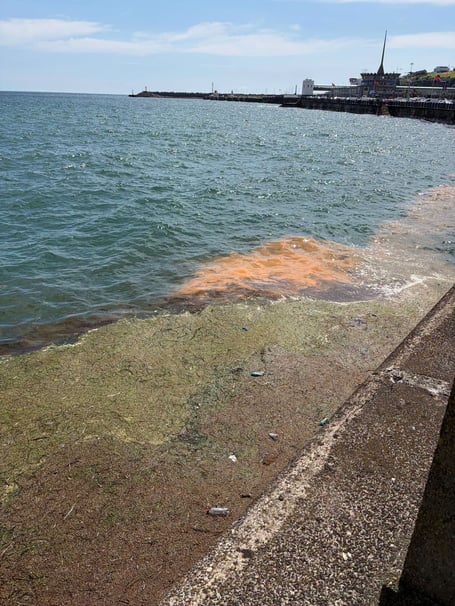
People have been noticing a strange orange slick floating around Douglas bay and other parts of the island’s coastline.
It has prompted concerns around pollution or sewage leaks but, thankfully, there is a more natural explanation.
The discolouration has been identified as a bloom of noctiluca scintillans, a naturally occurring marine plankton species that is periodically found in Manx waters during the summer months.
Similar blooms have been recorded around the island four times since 2018.
While noctiluca scintillans is not considered harmful to humans, the Department of the Environment, Food and Agriculture (DEFA) is advising the public to avoid swimming in areas where the water appears discoloured.
In some cases, dense blooms may cause minor skin irritation or respiratory discomfort for sensitive individuals. Such blooms can also attract other marine life, including jellyfish.
The appearance of these blooms is a natural phenomenon and they are expected to dissipate as environmental conditions change.
Taylor Bridgens, marine monitoring officer at DEFA, explained more about the orange algal bloom: ‘The Isle of Man's eastern coastline recently experienced an orange algal bloom, a striking phenomenon attributed to the presence of a microscopic marine algae called Noctiluca scintillans, commonly referred to as "sea sparkle" or “fire of the sea”.
‘While Noctiluca scintillans is non-toxic to humans, these blooms can be classed as a harmful algal bloom under certain conditions due to potential marine impacts.
‘It is a single-celled microscopic algae that thrives in coastal waters around the world. This phytoplankton species is interesting as it does not photosynthesis, but rather feeds on other marine microscopic organisms.



‘Additionally, Noctiluca scintillans is notable for its ability to produce bioluminescence, leading to its nickname of "sea sparkle". It can appear orange due to the ingestion and accumulation of prey items.’
The right nutrient supply, light and water temperature can spark an algal bloom.