

A long-standing bus drivers’ dispute is close to being settled at last.
It has emerged that the Unite union still has a valid mandate for industrial action which has been in place for more than two and a half years.
A government spokesman said: ’Technically, Unite the Union remains in dispute.
’The strike ballot is being rolled forward regularly by one member working to rule just often enough for the ballot to remain valid under employment law.



-(2).jpeg?width=209&height=140&crop=209:145,smart&quality=75)
’This has no impact at all on our services to the public.’
But it looks like the dispute could soon be over, at last.
The spokesman said: ’I am, however, pleased to say that relations with bus driving colleagues have improved to the point where the union’s representatives have written to advise that they will now consider ending the dispute with the department.’
The dispute follows a ballot taken in May 2016 for discontinuous industrial action over ’unfair and discriminatory’ management practices in relation to disciplinary procedures.
Ever since, a union representative has notified the department on a monthly basis that they are taking part in a work to rule.
There have been no fewer than 32 such occasions since May 2016.
The government spokesman said: ’Unite the Union has undertaken 32 periods of industrial action since balloting in May 2016 over an issue that was raised by the union in respect of the application of disciplinary procedures to bus driving staff.
’These actions have all consisted of one employee working to rule for one day per month and have had no impact on the delivery of services to the public.’
Unite members of Bus Vannin took part in a series of strikes over changes to the terms and conditions, beginning in December 2012 and culminating in a 12-day strike during TT 2013.
Bus drivers subsequently began working to new contracts which involved longer shifts, a 10% pay cut and the loss of paid lunch breaks which aimed at saving £300,000 a year.
Two bus drivers took the government to employment tribunal in a test case but their claim of unfair dismissal was rejected in 2014.
The tribunal heard that 91 Bus Vannin drivers had accepted the contract changes while reserving their positions.
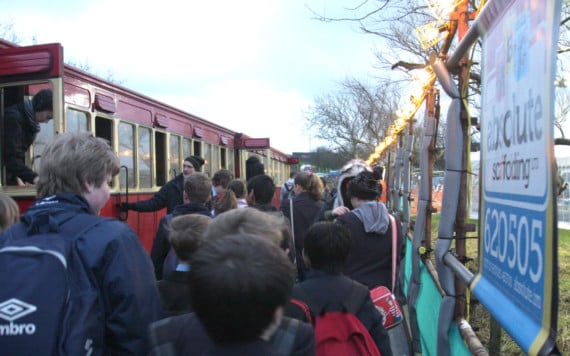
During the 2013 strikes, a temporary platform was erected on Castletown bypass so pupils at Castle Rushen High School could go to school by train.
Then in 2017, bus drivers staged a work-to-rule in a dispute over taking time off during the TT. Bus Vannin management said that as the number of drivers had fallen from 110 in 2012 to 92, the number on holiday in any one week needed to be cut too - and £100,000 could be saved by reducing holiday cover by two full time drivers.
This dispute, too, has been settled.
In a consultants’ report about Bus Vannin, commissioned as part of the government’s SAVE programme, it was noted: ’The Isle of Man’s bus service used to be seen as the home of militancy and constant management versus union conflict.
’The threat of strike action has reduced since a series of strikes over new payscales in 2012/3.’
Comments
This article has no comments yet. Be the first to leave a comment.