
When 42 passengers and crew departed Ronaldsway on February 27, 1958, no-one could have guessed that in less than a hour there would only be seven of them left alive.
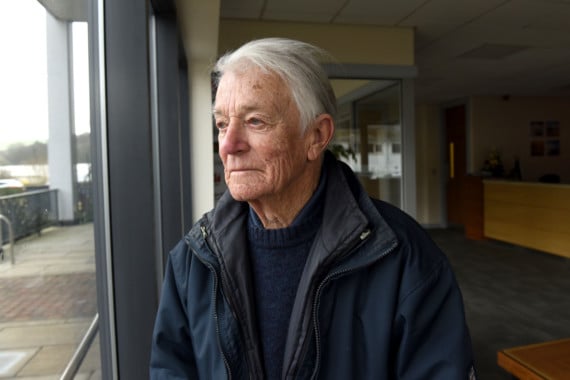
Of those seven survivors, three crew and four passengers, Norman Ennett is now the last.
This week, he recalled his memories of the crash and its impact on him and the island as a whole.
’We had an invitation to go to the Manchester Exide Battery factory and we’d fly from Ronaldsway,’ he explained.
.png?width=209&height=140&crop=209:145,smart&quality=75)
-(1).jpeg?width=209&height=140&crop=209:145,smart&quality=75)
’I went to Ronaldsway about 8.30am and after us all milling around, I knew all the other motor traders, well most of them, by name.
’I was talking to a couple of lads when the pilot came out, who I knew very well and he said: ’Come on then, you can hop into the jump seat’.
’So he and the first officer climbed on the plane and the jump seat you know it’s between the captain and the first officer but about three foot above them.’
Mr Ennett explained how despite being given a head set, he couldn’t hear anything, noting the primitive nature of the system compared to today.
He said the voices he could hear reminded him of ’Donald Duck, you know with the squeaky voice, that’s all I could hear’.
Mr Ennett said he knew the plane was flying at 1,500 feet and crew only realised they were tuned into the wrong beacon when Manchester control told them ’you’re heading for Wigan’.
Following this, the crew were given the order by Manchester control to ’make a right turn immediately on to a heading of two five zero’.
It was during this turn that the plane crashed into Winter Hill, just short of the summit.
Mr Ennett described the crash: ’We hit the bloody hill, you couldn’t see anything because of the cloud or mist and the white ground, snow on the ground. It just fell to bits.
’My harness broke or snapped and I fell down behind the captain and the first officer and I was knocked out.’
The design of the plane likely explains the survival of the crew and Mr Ennett. As the aircraft was a ’ferry plane’, the front was designed to lift up and be used to carry large items such as cars and this space sustained most of the damage at the nose-end of the plane.
Mr Ennett explained he remembers the first officer William Howarth, stuck his head inside and said to the captain ’I can’t see a thing, but there’s a track, I’ll follow this track and see where it leads to’.
After about half an hour, Mr Howarth returned with two men he found working in a radar station hut.
’I got out through the hole in the side and I had no shoes and no watch, must have shot off all over the place, I looked inside but I couldn’t find them anywhere.
’I walked down to the radar station and I didn’t see anything of what was left of the plane.
’I saw the stewardess Jenny Curtis was walking around looking a bit lost and the captain was trapped with the rudder bars, he couldn’t move.
’The road was snow bound, so they couldn’t get an ambulance or anybody up there, but eventually a doctor walked up with a policeman and some other chap.’
It was a chance meeting years later when Mr Ennett would discover who the other ’chap’ was. Having spent a number of winters in Spain, Mr Ennett was in a pub where he got talking to a fellow drinker who was from Bolton.
I said: ’I was very near Bolton once you know, I was in Winter Hill. ’’Winter Hill’’ he said, I said ’yeah a plane crashed many years ago’.
’He said: "I was involved in that" and I said ’were you?’. He said "We had a chemist shop in Horwich and a doctor had to walk up the hill and I carried the bag.’
During the crash, Mr Ennett suffered a broken arm, wrist and shoulder, cuts to his face and a piece of perspex was stuck in his forehead.
Mr Ennett said he wasn’t sure how long he spent in hospital, saying it could be ’three, four days, maybe even a week’ but does remember when his wife came to see him.
’They flew my wife over to see me and I’m there laying in bed and she walks right past and didn’t recognise me, so I shouted to her and she came round and burst into tears.
’I couldn’t work out what was wrong with her, I was alive, head bandaged up but that’s all. Then I went to the bathroom a couple of days later and looking in the mirror.
’ I thought there was someone else in there with me, my head was massive.
’I had red eyes, like they do them in films now like alien eyes. The hospital staff were very good and efficient, but it was something that should never have happened.’
Despite having survived a plane crash, Mr Ennett says that he flew home after his time in hospital: ’If you fall off a horse, you’ve just got to get back on.’
When he returned to the island, he spent three months off sick as his arm healed but remembers his dad attending funeral after funeral.
He also remembers the effects on the community of the crash: ’The majority were in the garage business and it flattened the place.’
With the event so clearly in his mind, I asked Mr Ennett why he had waited until now to attend a memorial at the crash site?
He said he has been to Bolton several times, and has even had a drink in a pub at the bottom of the hill, but had no desire to go see it.
’On the 25th year they had a trip but I never wanted to go and the 50th I just went to plant a tree so I thought well I’m 84 now so I won’t last a hell of a lot longer so I thought well I’ll go.
’Now at least I’ll be able to see the hill again.’
I asked if he thought the island does enough to commemorate the crash?
’It was a very tragic event at the time and it didn’t get an awful lot of publicity as it was just after Manchester United crashed in Munich so that obviously got a lot more publicity as a football club.
’A lot of people, well actually I suppose for years, everybody knew about it but not now. So I said to my son who’s 58 that I was going and he lives across by Twickenham and he said ’I’ll come with you, I’d love to come up and have a look’.
’The Rotary Club in Horwich has a museum now so they tell me, so I’ll have a look around and I’m sure it will be very interesting but I think it will gradually finish as 60 years is a long time to think about anything.’
â?¢ As well as organising a group to travel from the island to Winter Hill for memorial events with the Rotary Club of Horwich, The Rotary Club of Douglas is holding a memorial service at the site of the memorial plaque in Cooil y Ree Park, in St John’s, at 11am today (Tuesday).
Sixty years ago today Norman Ennett was one of the few to survive the Winter Hill air disaster. Here he tells Sam Turton why he’s chosen to go back to the site for the first time.
Comments
This article has no comments yet. Be the first to leave a comment.