
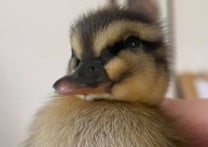
We know spring has sprung here at Ard Jerkyll when we start to see ducklings, and sure enough we’ve had several different sibling groups brought in over the past few days.
But please don’t assume that a lone duckling, even a forlorn looking one, has been abandoned - it’s likely that its parents and siblings will be close by, and the best course of action is to observe the young bird for as long as possible (ideally for at least an hour).
If it is in immediate danger from a predator or passing vehicles, carefully relocate it to a safe place nearby if possible. It is vital that the parents should still be able to see and hear their offspring, and so it needs to be placed out of danger but near to where it was found.
However, if the duckling is clearly injured it will need to be taken to a vet for treatment, before it comes to Ard Jerkyll.



When they arrive at Ard Jerkyll young ducklings are kept in heated incubators (coincidentally, the collective noun for ducklings is an ’incubation’), and although they can swim from day one of hatching they are at risk of drowning, and so they have to be supervised when they are in water.
For this reason they must be given drinking water in a very shallow bowl or special drinking container. When they are old enough they are moved to the outdoor aviary pens where they can develop their swimming skills in large water troughs before being released back into the wild.
Ducklings do well when they are reared in captivity, not least because they are fairly self-sufficient as soon as they hatch, but other species of bird are more of a challenge because they need regular hand-feeding.
Members of staff take these birds home with them so that they can be fed from dawn until dusk, as they would have been by their parents, and we are given invaluable support by the team at Manx Wild Bird Aid to help us to do this. They are usually able to take the smaller birds from us (sparrows, robins, blackbirds, etc), and get them to a point where they can go into an outdoor aviary before being released.
Hatchlings sometimes fall out of their nests, and every effort should be made to put them back again if possible.
Fledgelings, like ducklings, often seem helpless but they need to spend time on the ground whilst they develop the final stages of their flight feathers. The ’watch and wait’ advice applies here too, and usually the fledgling’s parents will appear before too long.
The biggest threats to fledglings are larger, predatory birds and cats. But if you’d like a cat who will happily ignore birds in your garden then Millie is for you.
She is a very sweet-natured ’senior kitizen’ aged 12, who likes the quiet life and simply enjoys a bit of pottering around, doing her own thing. She’s been very loved by her previous owner, who is sadly very ill, and perhaps a bit too well cared for - Millie is very overweight and clearly enjoys her food.
We think she may have a touch of arthritis which is why it’s really important for her to lose some weight, so that there’s less pressure on her joints. She’s now on a special diet and this will need to be carefully monitored by her new owners to ensure that the weight loss is achieved gradually over a period of time, and then maintained.
Millie doesn’t like other cats, and hisses if one comes close to her, and we anticipate that she won’t like dogs either.
But she will be the purrfect companion for a human being - could this be you?
If you’re not in a position to adopt an animal from us, but would like to support us in other ways, please note that our tearooms are back up-and-running again, as are our charity shops.
The shops anticipate a lot of post-lockdown donations which will need to be sorted and so are asking that clothes and bric-a-brac be dropped off on certain days only: the Douglas shop in Bucks Road’s days are Tuesday and Friday and the Ramsey shop in Parliament Street’s are Tuesdays and Wednesdays.
Comments
We've recently changed our login process. If you have an account for commenting, you will need to re-register on the login window.
This article has no comments yet. Be the first to leave a comment.