
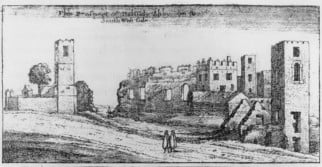
On Wednesday November 15, UCM’s History & Heritage lecture series continues with a lecture by Dr Peter Davey on the early history of Rushen Abbey.
Rushen Abbey is one of the most important medieval religious sites on the Isle of Man. The abbey was founded in 1134, when Olaf I, King of Man and the Isles, gifted land on the island to the Abbot of Furness Abbey in Cumbria. Initially, Rushen Abbey was part of the Order of Savigny, which was founded in France in 1105. However, by 1150, both Rushen Abbey and Furness Abbey had been absorbed into the Cistercian Order.
The abbey was hugely influential on the island, not least due to its significant landholdings. At the time of its dissolution, it held lands as far north as Sulby, and as far south as Colby. The Chronicles of the Kings of Man and the Isles was probably written by the monks at Rushen Abbey during the 13th and early 14th centuries. The manuscript is written in Latin and tells the history of the Kings of Man from 1016 to 1316. It is now held in the British Library.
The Dissolution of the Monasteries began in England and Wales in 1536, under King Henry VIII. Furness Abbey was surrendered in 1537 and in 1540, Rushen Abbey was dissolved by Edward, the 3rd Earl of Derby, along with Douglas Priory and Bemaken Friary. The Abbot and the six remaining monks were expelled from Rushen Abbey on June 24 which, at that time, was Midsummer Day and Tynwald Day, as well as being the feast day of St John the Baptist.




After the Abbey was disbanded, the buildings fell into disrepair. Today, the remaining upstanding buildings include part of the Abbot’s lodgings, some of which are now used as exhibition space; the tower of the abbey’s Church; part of another, smaller tower, which may have been a gate-house tower; and a barrel-vaulted structure, likely to have been the Chapter House, where the Abbot would read from the Rule of St Benedict each evening.
The oldest and most important part of the abbey was the church. It was built to a cruiciform (cross-shaped) plan using both local and imported stone. In 1257, the church was dedicated to St Mary the Virgin by the Bishop of Sodor and Man. The church tower, which still stands, was a later addition, and was probably constructed in the 14th century.
Basil Megaw, former director of the Manx Museum, argued that the original location of Rushen Abbey was the current site of Castle Rushen, and that the abbey moved, first to Douglas, and then to its present site in Ballasalla. The argument was compelling, and this interpretation has generally been accepted. However, in his lecture on ’The Monastic Church of St Mary of Rushen: Archaeology, Architecture and Function’, Dr Davey will set out to refute this argument, using the evidence obtained from eleven seasons of excavations at the abbey, between 1998 and 2008.
The lecture will examine the context in which the abbey was founded, the size and plan of the church, the dating of its various elements, and its architectural features. These will be discussed against the backdrop of the changing architecture of Cistercian abbeys elsewhere in the British Isles, and particularly with Grey Abbey in County Down. In light of this evidence, Dr Davey will argue that the Church of St Mary of Rushen was built before 1170, when changes to the form of Cistercian abbeys were introduced. This argument also has implications for the dating of Castle Rushen which, following Megaw’s theory, is generally believed to have been established in the late 12th century, once the abbey had moved to Ballasalla.
Dr Davey was Reader in Archaeology at the University of Liverpool and Director of the Centre for Manx Studies until his retirement in 2007. He has worked on monastic sites in France, the Low Countries and in Britain and has a particular interest in the material culture of the Middle Ages in the Isle of Man.
He is co-author (with Jim Roscow) of Rushen Abbey and the Dissolution of the Monasteries in the Isle of Man (2010) and author of After the Vikings: Medieval Archaeology of the Isle of Man AD 1100-1550 (2013).
Dr Davey’s lecture on ’The Monastic Church of St Mary of Rushen: Archaeology, Architecture and Function’ takes place at 6pm on Wednesday November 15 in the Main Hall at University College Isle of Man, Homefield Road, Douglas.
All are welcome, and no booking is required.
The lecture will be recorded and then made available online at a later date.
For further details about the History & Heritage lecture series, together with videos of last year’s lectures, look online at http://catrionamackie.net/lectures/.
Comments
This article has no comments yet. Be the first to leave a comment.