

An undersea nuclear disposal facility could be built within eight miles of Manx territorial waters.
The UK’s Nuclear Decommissioning Authority (NDA) has relaunched its search for the site for a geological disposal facility.
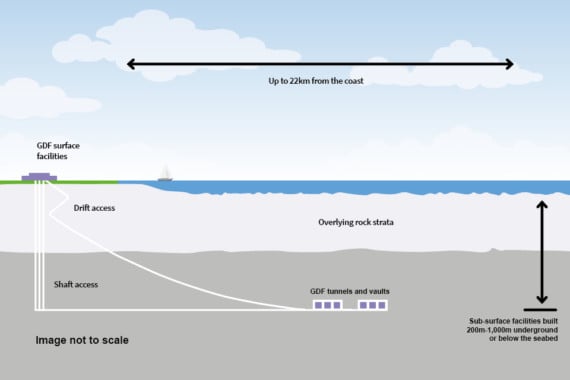
And one option that is being considered is to build it under the Irish Sea up to 22km out from Sellafield.
This would bring it within six to eight miles of the island’s own 22km (12 nautical mile) territorial limit.




Tim Knowles, who chaired the West Cumbria Managing Nuclear Waste Partnership as executive member for the environment at Cumbria County Council, believes this is the preferred option.
He told the Examiner: ’The NDA favours an undersea solution to high level nuclear waste disposal.
’The preferred scheme - although they may deny it - is to tunnel out from the Sellafield area 22km or so to what is considered "suitable" geology.’
The distance from Maughold to Sellafield is 54km or 33.5 miles.
Radioactive Waste Management (RWM) is the NDA subsidiary responsible for implementing the long-term solution for managing high level nuclear waste.
A spokesman said it was some years off identifying a site for a geological disposal facility (GDF) and is at the very early stages of talking to communities interested in hosting one.
She said: ’We don’t yet know where a GDF will be built.
’It is possible to have the underground part of a GDF in deep geology hundreds of metres below the seabed, as well as underneath onshore land.
’Surface access would be onshore, and RWM would only look within the UK territorial limit, up to a maximum of 22km from the coast.’
The UK is the first country to publicly consider disposing of its high-level waste offshore.
A June 2020 scientific scoping study assessed three potential hydrogeological settings for deep radioactive waste disposal.
Two were onshore underground sites in West Cumbria and East Anglia, but the study found the most suitable was an offshore setting in the East Irish Sea Basin, in an area known as the Tynwald Basin.
The Manx government’s declared policy is to seek the complete closure of the Sellafield nuclear reprocessing plant and to oppose the operation of any nuclear facility which is the source of radioactive pollution.
In a statement, the Department for the Environment, Food and Agriculture said it was aware of developing proposals and maintains close links with the NDA on the restart of the search for an underground disposal site in West Cumbria or its immediate offshore area - which would now progress over a number of years.
It said: ’Although it may be that the proposal referred to by Mr Knowles is considered by proposers to be preferable to alternatives, it would need to go through a full planning process which will include consideration of risks and any other reasons for objection.
’For any objection or input by Isle of Man Government to be taken into account by the UK, it must be presented at the appropriate stage in the planning process.
’Any response in relation to this relaunch of the site search process cited by Mr Knowles will be considered by the department and take into account all relevant information.’
The previous search for a disposal site ended in 2013 when Cumbria County Council voted not to proceed.
Two working groups have so far been formed, both in Cumbria, at Copeland and Allerdale, whose borough councils are based at Whitehaven and Workington respectively.
But the NDA insists this does not mean an eventual location has been chosen. It anticipates more working groups will be formed.
A GDF will only be built where there is suitable geology and where a test of public support can be demonstrated, said the NDA.
’Communities can withdraw from the process at any time. If there is no support, a GDF will not be built,’ said the spokesman.
Whitehaven is about the same distance from the Manx coast as Sellafield (33.5 miles) while Workington is 38.5 miles from Maughold.
The Lake District National Park has been excluded as a site.
Comments
This article has no comments yet. Be the first to leave a comment.