
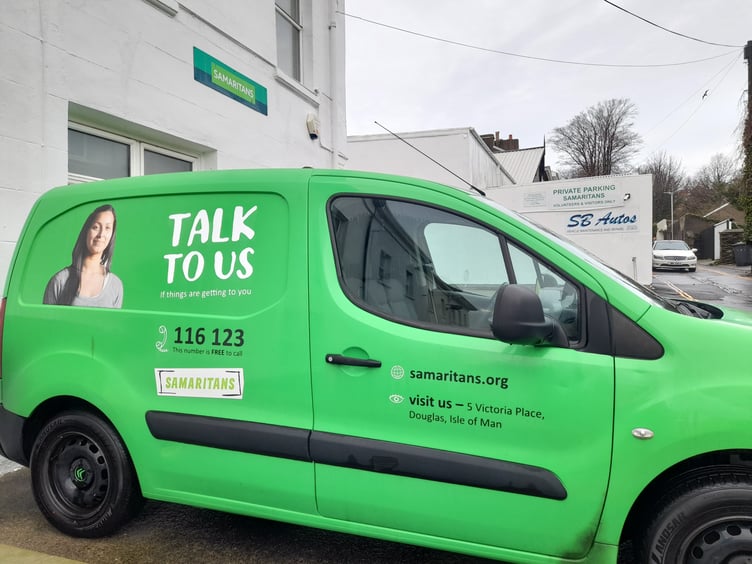
If you ever need to speak to someone, Samaritans are there. You can call them up ’for everything. Everything that’s bugging you - whether it’s a small thing or a big thing’.
That’s the message from Sinead Nudd, deputy director for outreach at the Samaritans’ Isle of Man branch.
Over the festive period, the charity expects to take about 250,000 calls, according to analysis from previous statistics.
A large reason they take so many calls is the fact that the charity is never closed.
.jpeg?width=209&height=140&crop=209:145,smart&quality=75)
.jpeg?width=209&height=140&crop=209:145,smart&quality=75)


As Sinead says: ’Samaritans is 24/7, 365 days a year, so we don’t close for Christmas.
’That means volunteers, giving up time all over the Christmas period, make sure that we’re available over all our channels.
’That’s quite unusual for a help-line, because most helplines start to close down [in the run-up to Christmas], and don’t re-open again until after the New Year.
’We think it’s really important to be there, because people don’t have their normal support functions to rely on.
’Even people with carers or support workers, or whoever else, a lot of those people are not as accessible over Christmas as they normally would be.’
Samaritans was founded in 1953 by a vicar called Chad Varah, who wanted to help people contemplating suicide.
It has since grown into a massive organisation with 201 branches. During 2020, more than 20,000 people volunteered their time for Samaritans in the UK.
More than 16,200 trained listening volunteers responded to calls for help and over 3,200 volunteers supported the running of the branches. Prisoners even volunteered with the service as trained listeners - over 1,000 of them.
Every day Samaritans volunteers respond to around 10,000 calls for help in the UK. Callers contact the charity for a whole host of reasons.
Sinead said: ’The calls range across the whole range of human emotions really, from loneliness through to someone who is possibly at a very dark place in their life.’
And what about during the festive period?
’I think loneliness is a big factor,’ she says. ’And obviously, the pandemic plays into that, because some people can’t be with the people that they want to be.
’Then there are things like bereavement - all of that gets escalated, around the Christmas period.
’When you see people with family and you’re not with your family, estrangement from family is another topic. Domestic abuse can also go up, when people are sort of forced to be together.
’Financial pressures, you know, wanting to have a good Christmas and not really being financially able to do that.
’Some people don’t want to have anything to do with anybody else over Christmas. And yet they feel forced into that.
’So there’s a whole range of things that Christmas brings up for folk - and then there’s just a sprinkling of human emotion that doesn’t stop just because it’s Christmas.’
Volunteers for Samaritans go through a ’robust’ training regime before they can be signed off.
There are four training intakes a year, based on a standard recruitment process. If you are selected for training, you initially don’t answer calls, and for a while when you do, those calls are mentored.
As Sinead said: ’It probably takes about six months from the beginning of being selected, and joining the training to actually coming out the other end.
’So it’s a pretty robust training regime, and it has to be because volunteers have to be OK.
’Otherwise, they wouldn’t come back to do what we do. We have to look after them, and make sure they’re properly ready for what they might hear on the phone and know about the support that’s available internally to us as well.
’To enable us to deal with all of that.’
The volunteers were classed as key workers throughout the various lockdowns we have had on the island - which was helpful as they don’t do any working from home.
Instead, their base of operations is in Victoria Road, Douglas, where there are always two volunteers on shift at any given time.
A third volunteer does work from home, with the specific role of checking in with the others at the end of their shift.
An important part of their job is at the end the volunteers call them and debrief all of their calls with them,’ Sinead says.
’And the leader is there to sort of make sure the volunteers are right. If they’ve had a difficult call, you talk to them about how they’re feeling. And we might even then phone them the next day to see how they’re doing.
’That support system is really important to the well being of our volunteers.’
Whilst the charity does have approved signposting partners, they are always of the view that ’someone has phoned Samaritans for a reason’.
As Sinead said: ’If you wanted to get the number for Rape Crisis, or whoever else, you can look up those numbers yourself as easily as we can.
’So we’re always of the view that we treat the caller as a Samaritans caller in the first instance.
’If, in the course of the call, something comes to light, for example, someone talking about alcohol abuse and wanting to give up their drinking or whatever, we might then explore with them whether they would like to know about some other organisations that could specifically help them, but it’s not the first thing that comes to our mind.’
If you are reading this, and feel you may need help, the team at Samaritans stress that if you ring the charity up, you won’t necessarily get through to the Isle of Man.
Sinead explained: ’We are part of the national organisation, so our calls go to a central distribution point, and they’re just distributed to the next available volunteer. So you could be speaking to someone in London or someone in Edinburgh, Cardiff, wherever.
’That works well in two ways. [Firstly], people on the island don’t have to be worried about speaking to their next door neighbour or somebody that’s going to recognise you, and equally for our volunteers, they don’t they don’t have to worry about that either.
’So it increases the anonymisation for our callers.
’We don’t know where our caller is calling from, we don’t do any sort of call trace, and we don’t do any analysis. It’s only if the caller happens to mention where they’re from that we know.’
So what is the key message the charity want people to remember?
’Please know that we are there all of the time, all of the year. We’re not just there for when people are suicidal, we’re there for everything, everything that’s bugging you, whether its a small thing or a big thing.
’You know, we really, really want people to just pick up the phone or send an email, and have a chat with us, because that can often help reduce the impact of the thoughts in your head or the feelings that you’re having.
’There’s no shame in phoning Samaritans. Definitely not.’