
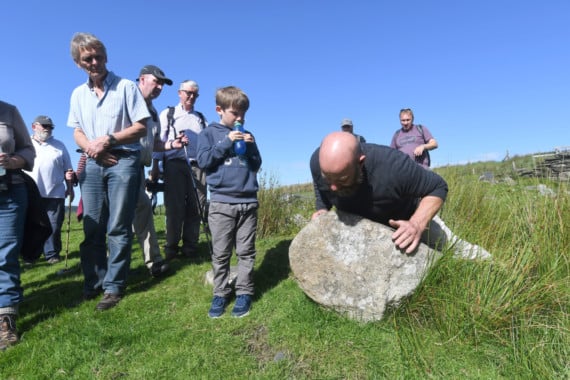
Under the bright sunshine and flawless views of the lush and verdant Manx countryside, it is easy to think about how nice it would be to live a simple existence as a crofter or a farmer in one of the many tholtans that dot the landscape.
However, those who attended the Isle of Man Antiquarians’ guided walk around Glen Rushen, lodged in the valley between South Barrule and Slieau Whallian, were left in no doubt how hard and mean the lives of those who worked the land would have been.
’It’s windy and exposed, the ground is often wet and boggy, the soil is thin and it gets dark quickly, no matter the time of year. I wouldn’t fancy living up here!’ said Paul, himself a farmer, based in Moorhouse Farm in Colby, who rears sheep and highland cattle in the valley.
The walk, which was held last weekend, took in many elements of the island’s past, including mining and farming and, in particular, spelt out the harsh conditions of those who eked out a meagre living on the slopes of Glen Rushen.
.jpeg?width=209&height=140&crop=209:145,smart&quality=75)
.jpeg?width=209&height=140&crop=209:145,smart&quality=75)
.jpeg?width=209&height=140&crop=209:145,smart&quality=75)
.png?width=209&height=140&crop=209:145,smart&quality=75)
All around the valley there are clumps of derelict tholtans, atmospheric in their ruin but once home to many families and spelt out in the names of some of old cottages, such as Balla Vaayl (Michael’s Place), Ballacottier (Cottier’s Place), Lola’s place and Juan y Cleary’s and many more, as well as ’Glion ny Vrack’, or ’Trout Glen’, which reflected the once-abundant fish that populated the rivers around the area.
With many of the menfolk employed at the two large mines and the women and children engaged in looking after the crofts, Glen Rushen, at various points in history, would have been remarkably well-populated.
At the height of the mine’s working life, it is estimates that around 300 people lived and worked in the area, with records existing of at least 28 families.
All around the valley there are still remarkable signs of the scale of the industry.
The remains of a large dam, some thirty feet high, still exist in a hidden gully, which would have once provided water for the surrounding area as far as Peel and, as the walk progressed on towards the impressive Glen Rushen farmstead, the walkers went past the remains of a Wesleyan chapel, which is on record as late as 1930 as holding a congregation of around 70 people.
The walk also featured areas that touched on Manx folklore and fellow walk guide Katie Newton read extracts from tales that emanated from the area.
One huge granite boulder, lying near to a ruin called ’Chlie ny Fanney’ is reputed to be a stone flung by an angry Phynoderee at his fleeing wife as she ran to Ireland and still bears a stain, claiming to be blood from where the rock hit her ankle.
Another potentially grisly rock is known as the ’killing stone’, found at Mullen y Seayle, and features a niche in which an person or animal’s head or body part fits just nicely to be hacked off.
Another less entertaining theory, that the stone is a prop for a mill working, arose during the walk. That, however, was promptly dismissed by Katie’s six-year-old son William Newton, who much preferred the more gory explanation.
Paul also told of how the area has been used by the SAS for parachute and survival training as recently as 10 years ago and that he still sometimes finds people panning for gold in some of the streams that run down through the valley.
The walk was an engrossing trail through a stunning landscape of history, industry, people, place and folklore, which made for a hugely enjoyable afternoon.
Pat Newton, who organised the walk, said the place remains endlessly fascinating and it ticked all the boxes for the Isle of Man Antiquarian Society.
’This area has always seemed to be rich in history and folklore,’ said Pat.
’During the mining period, this would have been a valley that would have been extremely busy.
’The people here would have been miners and part-time crofters, with the men doing the mining and the women looking after the crofts.
’There were over 300 people and there are records that show something like 28 families, living here at the time around 1881, with a lot of households and tholtans dotted all around the place.
’It is rich in farming history, mining history, folklore, everything.
’It ticks all the boxes for the Isle of Man Antiquarian Society and on a day like this, who could complain?’
More information on the Isle of Man Antiquarian Society is available at
manxantiquarians.com
Comments
This article has no comments yet. Be the first to leave a comment.