

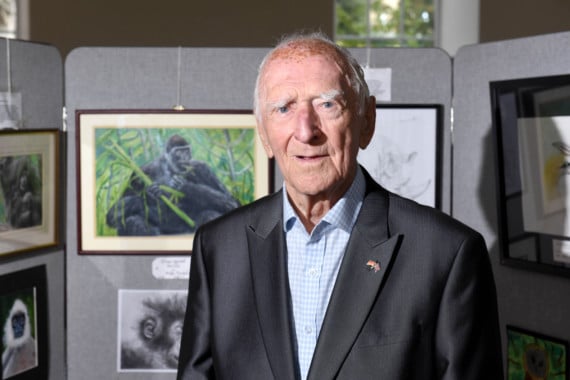
War hero Hector Duff has told the Examiner that he is fully behind efforts to prevent further damage to wildlife.
The former soldier, police officer and driving instructor, who has taught generations of school children about conflict, has earned the right to take it easy but he is keeping as busy as ever.
Growing up in Sulby, Mr Duff was surrounded by wildlife, from birds to insects and farms to wild flowers. He is concerned about declines in the population of wildlife and a drop in the number of wild flowers.
’You see it on television about the dolphins, elephants and pandas all suffering and we don’t do a thing.



’I don’t know anything about the science, but the changes since I was a child are amazing.
’The change in the weather is the main thing you can see.’
Mr Duff, 99, said that his appreciation for wildlife came from spending his childhood roaming the countryside looking for animals and playing in fields.
He added: ’We’d see corncrakes and cuckoos and all those sorts of birds. We had an awful lot of pleasure out of going out looking for their nests.
’There is an awful lot of enjoyment you can get from seeing and hearing these animals in nature.’
For reasons such as those, Mr Duff said it was important we take steps to protect animals and their habitat and that included in how we build modern housing to meet a growing population’s needs.
He said: ’We must provide somewhere for people to live, but it has to be done in a way that protects the wildlife.’
And Mr Duff said that in the years he has spent visiting Manx schools, he has noticed a move towards protecting the environment.
’The children are more informed on what we can do and what we can’t do.
’It is up to us to do something, by planting more grass and more trees and using solar power.
’When we go away, you see thousands upon thousands of solar panels, we’ve got to find an alternative to the energy sources we use.’
Mr Duff recently opened an art exhibition exploring endangered animals. He said: ’I was proud to be invited to open an art show gathered together by works from the children of Peel Clothworkers’ School and the University of the Third Age art group.’
Comments
This article has no comments yet. Be the first to leave a comment.