
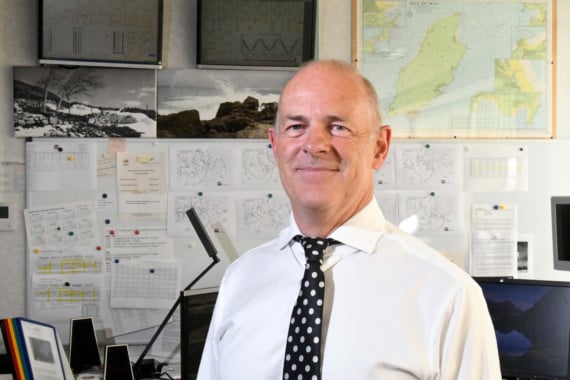
As the island prepares for the colder and wetter months to come, we spoke to the team who work 24/7 at the Isle of Man’s meteorological office to provide constant weather monitoring.
The Ronaldsway-based team receive their data from 31 automatic weather stations situated across the island, from the plantations to the tide gauges in the harbours.
One of the office’s primary roles is to provide detailed reports to air traffic control every 30 minutes and a specialist forecast every three hours, as well as reporting directly to pilots who need to know the most up-to-date information.
Alongside this, the Met Office provides the essential local information required by a number of vital agencies.

.jpeg?width=209&height=140&crop=209:145,smart&quality=75)
Senior meteorological officer Adrian Cowin explains this ’multi-agency’ role, saying: ’Beyond the airport, the rest of the Department of Infrastructure and other government departments want their warnings - our forecasts go to the Highways Division, the Department of Home Affairs, Manx Utilities, and the emergency services.’
The office also contributes data to UK forecasts - such as the inshore shipping forecast which is sent to the UK Met Office headquarters, and to BBC Radio 4’s shipping forecast.
The office’s warning service also becomes key during the autumn and winter months, with the normal ’lead time’ for producing warnings typically being between one to three days ahead.
Mr Cowin added: ’It depends on the state of the atmosphere and weather patterns leading up to the event, how unpredictable a mood mother nature is in.
’The computer models we use help us determine forecasts out to at least five days quite accurately, so we produce a forecast and highlight any particular things that might be of concern - gales or heavy rain for example.
’Particularly for our multi-agency partners like the highways division or Civil Defence - we need to warn them to help them to have resources like manpower or machinery in place.
’If necessary we can get everyone together in the same room and we can give them a briefing - show them the graphics and the details, what the impact is likely to be, so they can go away and plan their response which will mitigate or reduce the impact of a severe weather event.’
However, Mr Cowin stresses that unpredictability is often the ’nature of the beast’ when it comes to weather, as shown by the recent flash-flooding in Laxey.
He explained: ’That was one of those unpredictable moments, because that was a thunderstorm which cropped up out of the blue.
’Thunderstorms are rare events in the Irish Sea, nevermind a little target like the Isle of Man.
’They only show up on the radar at the last minute when it bursts into life and then it will clobber one location very quickly.
’Even the previous October’s flooding event, though there were warnings for heavy rain, the variation of rainfall across the island was amazing. Many parts of the island only got 20mm of rain, like we did here at Ronaldsway - but the station above Laxey had 100mm.
’These localised heavy downpours are still some of the most difficult things to predict.’
By contrast, Meteorological Technician Gary Salisbury notes that the heavy snowfall of 2013 was ’extremely well predicted, with us able to announce a lot of specific detail - that it would be wet on the east of the island but deep snow on the west’.
Mr Cowin added: ’Because we know the shape of the Isle of Man, we knew what was going to happen in that event.
’And we do that daily, for example with the visibility at the airport - we know the situations when fog and low clouds are likely to affect the airport, and so can issue the appropriate warnings.
’On those same days that it’s foggy in the south we can usually have the same confidence to say that it will be bright and with sunshine in Peel and Ramsey - the difference being made by the hills acting as a filter for the moist air carrying the mist and low cloud.’
He says this same effect makes reporting for the TT one of their most difficult tasks, as the course covers such a distance over a range of different heights.
He explains there can be ’completely different conditions at the Grandstand to what you’re going to have on the west side of the course’.
’The sun’s always shining in the north, so that part of the course is usually clear - but just when they’re enjoying a good day of racing they come up the Mountain Road, and they have completely different and changing conditions.’
The work of the Ronaldsway office highlights the importance of detailed, local weather reporting which provides information that national forecasts cannot.
Mr Cowin says: ’The big picture of the UK forecasts may be right, but the detailed picture may be misleading.
’That’s the quality, the added value which we bring. ’For instance the national forecast won’t necessarily tell you about sea or hill fog.
’An app on your phone or the UK television broadcasts just won’t go into that level of detail.’
Asked whether it was busy working in the office overnight during nice weather, he said: ’The night shift is quieter but there’s still routine work to be done.
’The hourly observations still have to be completed and sent off to the international system. We also take a few phone calls during the night - from local fishermen, passengers concerned about their ferry or flight the next day, and we also talk to the captains on the Steam Packet ferries who call us whenever they want an update.
’And of course everybody is wanting the day’s latest forecast available on their phones, so the only way to have that available is to update everything during the night so by 4 or 5am that update is published and sent out on the Government’s website.
’During the night, especially during the wintertime we also act as the eyes and ears for the DoI - so if we spot something which needs a response during the night, we can alert the on-call duty officer that he may have to consider doing something before the morning traffic -like sending a gritter out.
’We also monitor the Mountain Road and control the matrix signs, which we can update if there is a weather hazard or if asked to by the police and highway officers.’
On the other end of the scale, a number of people even call in to ask if they can put the washing out, or play golf the day after.
Mr Cowin added: ’Another classic is school sports days. The pressure you’re under when someone asks "Is it going to be alright for school sports day at Marown tomorrow?"’
He says these types of calls keep things interesting and varied, saying: ’The Isle of Man should celebrate the fact that they have access to a local Met office, it is a service to the public. You can’t do that elsewhere.’
Comments
This article has no comments yet. Be the first to leave a comment.