

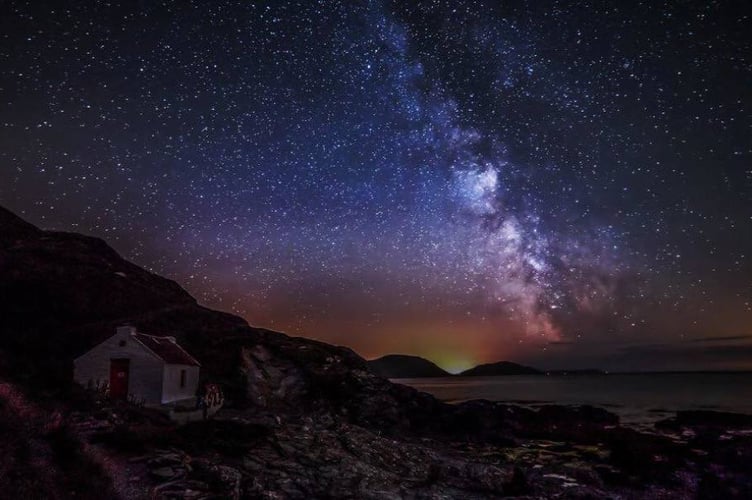
A week celebrating dark skies will start from Sunday.
It will be marked from April 16 to 23 and is a chance for people to look up and see what’s present in our Manx skies.
Local astronomer Howard Parkin, the International Dark Skies Ambassador for the Isle of Man, explained what can be seen in the skies from here.
‘In 2023 we have two planets visible with the naked eye in our Manx skies,’ he said. ‘Mars is visible as a distinctively red coloured “star” in the south western after sunset.
.jpeg?width=209&height=140&crop=209:145,smart&quality=75)



‘Mars is nestled between the stars of Taurus and Auriga but will by the end of April be lost in the evening twilight.
‘Venus is very easy to spot – it’s very bright in the western sky after sunset. It is pulling away from the sun and is very easy to see.
‘It will, over the coming months, get brighter and brighter in the morning sky before sunrise but will disappear into the dawn twilight by the end of May.
‘Jupiter is easy to see in the southern sky in the early hours and rising before midnight by the end of May will be easy to spot as the brightest object in this part of the sky.
‘Finally, Saturn is much fainter and to the left of Jupiter.’
Mr Parkin explained that following spring equinox last month, the bright winter constellations of Orion, Taurus, Canis Major and Canis Minor are slowly disappearing into the twilight sky in the west, leaving just the bright constellations of Auriga, Gemini and Taurus still visible throughout April and early May.
He added: ‘Gemini is easily recognised with two bright stars side by side and from a dark sky location it is possible with a bit of imagination to make out two stick like figures which represent the twins Castor and Pollux, the twin sons of Zeus.
‘Gemini is one of the brightest signs of the zodiac and is followed across the sky by the constellations Cancer the crab, Leo the lion, Virgo the virgin and Libra the scales, all of which can be clearly seen in our Manx night sky.
‘In Leo and Virgo are two of the brightest stars in the night sky.
‘Leo is very easy to see as a lion, as the star Regulus marks the “dot” in a reversed question mark which makes up the lions’ head and chest. Regulus is also known as the ‘King or Royal” star and is located near the lion’s heart.
‘Spica is lower and to the left of Regulus and is so called as it denotes a sheaf of wheat held in Virgos hand denoting the harvest, because as explained above the sun passes through Virgo in September.’
When looking towards the northern horizon, the observer would see the Plough almost overhead.
‘Just follow the curve of the handle of the Plough down and you will come to another bright star, Arcturus, the fourth brightest star in the night sky,’ the astronomer said. ‘Arcturus is the principle star of the constellation of Bootes the herdsman, which is more easily recognized as a kite-like shape.’
The best time to see meteors is usually after midnight, once the Earth has turned on its axis.
Comments
This article has no comments yet. Be the first to leave a comment.