
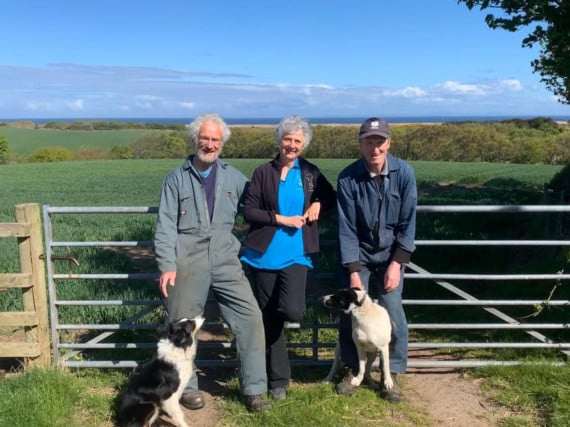
The recent opinion piece in the Manx Independent’s Food and Farming pages by Manx NFU general secretary Andy Cooper got many of you talking, including Steve Martin from Smeale Farm in Bride.
Steve, a former Manx NFU general secretary himself, took issue with some of Andy’s comments, including his assertion that ’We now grow just 250 acres of potatoes across the whole island and the reason for this is that, in 2020, the land is being farmed to what it is most suited for and most of our island is suited to growing grass to rear livestock.’
As well as disagreeing with Andy, thinking about this issue also prompted Steve to recall how farming used to be in the island when he first started out, 50 years ago, which may very well spark some recollections from other readers.
He and his brother, Chris, now rear sheep for finished lamb production and also grow milling wheat, along with barley, oats and peas for animal feed.


.jpeg?width=209&height=140&crop=209:145,smart&quality=75)
-(4).jpeg?width=209&height=140&crop=209:145,smart&quality=75)
Steve’s wife, Beth, runs two self-catering holiday cottages and organises farm tours.
Steve also took issue with Andy’s comments about local food production, when Andy said: ’Eventually we would reach that tipping point where the Manx cost of production is equal to the imported cost of production’ and ’we would be selling enough to reduce the cost of production and then be able to reduce the selling price’.
His own experience over the years has caused him to believe that it is a range of factors that have influenced what Manx farmers now find viable to produce.
Steve said: ’We used to export our oats to Mornflake, but in recent years the price offered was just too low to stand the freight charges for exporting, once again it is that expensive stretch of water.’
Steve worked for the Manx NFU in a number of roles for more than 40 years and he also recalls that, during the two years he spent as general secretary, his assistant was a young man named Howard Quayle...
Steve writes: ’One of the few welcome features of the current Covid-19 situation is the public’s greater interest in and support of locally-produced food in the island.
’We hope that this positive development will continue long after the current crisis is over, bringing benefits not only to the primary producers of our food, but to the community and island as a whole as the attractions of quality and low food miles are more readily appreciated.
’The situation also triggered thoughts about some of the changes I have seen in food production in the island since starting out in farming some 50 years ago.
’Back in the late 60s and through the early 70s, a high proportion of farms here in the north (probably in other parts of the island too) grew potatoes as a matter of course and many cultivated vegetables as well.
’There were any amount of greengrocers in our local towns, I can remember delivering a wide range of vegetables including cabbages, turnips, sprouts, calabrese, cauliflower and of course potatoes to Bernie Strickett’s in Parliament St, Ramsey, the two Conibear’s shops on Market Hill and to Mr Alexander’s shop in Tower Road. My cousin Dave Martin at Knock y Dhooney recalls delivering spuds and veg to 13 shops and three chippies in Ramsey with his father in their old Bedford van in the early 70s.
’However, with the introduction of supermarkets and cheaper imports came a sea change in shopping habits and most of the specialist greengrocers sadly disappeared.
’The knock-on effect was of course that most farms were forced out of growing potatoes and vegetables.
’It wasn’t that they decided their farms could only grow grass, it was a lack of demand for their produce and simple economics.’
Steve continues: ’Another major blow to the local potato industry came probably in the early 70s when, what had been a thriving export trade in seed potatoes for Nickersons, came to an end.
’The Isle of Man’s geographic position and high plant health record attracted the specialist seed company Nickersons to contract a significant tonnage of their seed potato requirements with local farmers.
’The growing crops and final samples were regularly inspected by officers from the then Board of Agriculture and it was a hugely important diversification for many Manx farms.
’However, with increasing freight charges and competition from Scottish growers in particular, the trade eventually ceased.
’It was another reason for the island’s potato acreage tumbling, it wasn’t due to a lack of expertise or availability of suitable land.
’I’m full of admiration for the current potato and vegetable growers in the island, large and small, as their crops are expensive to grow, labour intensive and very high risk with the vagaries of the weather and potential lack of demand for a perishable crop.
’Increased public support for these producers is good news and let us hope that far more of these crops are required by local consumers in the years ahead.
’It has been interesting to read stories in the national press about the severe shortage of retail packs of flour in UK supermarkets.
’How fortunate we are on the island to have our own supply of top-quality local flour from Laxey Mills and the willingness of the staff there to up production in order to satisfy the increased demand.
’It is worth noting that a few years ago there were well over 20 local farms producing high grade milling wheat for Laxey Mills, but now there are less than 10.
’The tonnage of milling wheat required by the Mill shrank as the level of bread and flour imports increased dramatically over the years.
’Once again it was a reduced product demand and economics that were the main culprits for the lower number of growers. Manx farms can produce a wide range of crops provided the business case for the required investment stacks up.
’One area where we will always be at a disadvantage is of course with the cost of production in the Isle of Man. Unless the Manx government is willing to provide hugely subsidised freight charges (highly unlikely) then the cost of importing seed, fertiliser, machinery, spares and other inputs invariably leads to an increased cost of production and this is before factoring in the economies of scale enjoyed by many enterprises across the water.
’Trying to cut our prices to match cheap imports would be economic suicide.
’A recent post on social media by Graham Crowe promoted the idea of bringing back the highly successful ’Thanks for Choosing Manx’ campaign and what an excellent and timely idea this is.
’The bags were top quality, the slogan was excellent and the sentiment spot on.
’Let us hope that the powers that be can be persuaded to take the appropriate action.’
Comments
This article has no comments yet. Be the first to leave a comment.