
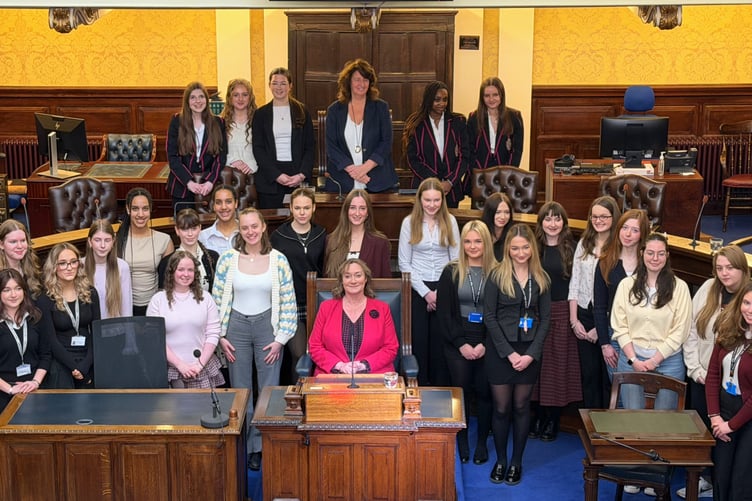
Young women from across the island held a debate in Tynwald recently to mark International Women’s Day 2026.
Ann Corlett MHK served as acting president of Tynwald for the sitting, which was organised by the Clerk of Tynwald’s office.
Five motions were moved; all prompted well-researched debate and all were carried unanimously.
Representing Douglas North, Holly McEvoy from Ballakermeen moved: ‘That this House is of the opinion that the government should strengthen the legal and accountability frameworks to address gender-based violence; and that further measures are needed to enhance victim safeguarding and to remove perpetrator anonymity in sexual offence cases.’



.png?width=209&height=140&crop=209:145,smart&quality=75)
Ahead of the debate she said: ‘In my research about domestic violence I’ve read how some women end up dropping out and not pursuing their case. I saw this event as an opportunity to share experiences and give young women a voice, particularly in matters of gender-based violence and perpetrator anonymity. I’m hoping to become a lawyer and I feel that to be able to speak in Tynwald could be really confidence boosting.’
Ellie Reynolds from QEII represented Glenfaba and Peel and focused on gender inequality in the diagnosis of neurodiversity disorders.
She moved: ‘That this House should establish if there are gender differences in accessing timely diagnosis; and that access to support in the island is variable.’
She said: ‘I wanted to highlight a neurodiversity issue that’s not often spoken about: how boys often receive a diagnosis at a younger age than girls. Very often young women tend to mask their symptoms, so I wanted to take part in the debate to raise awareness about educating people to recognise the signs and the need for greater support.’
Representing Ramsey, Emily Musgrove from Ramsey Grammar moved: ‘That this House is of the opinion that the island education institutions should directly teach students about gender discrimination.’
She said: ‘Right from primary school age I’ve noticed how there can be subtle gender differences - in the choice of language used, for example – which create gender stereotypes.
‘Young children are impressionable and those stereotypes can carry on into later life.’
Speaking on the topic of gaps in women’s healthcare Katie Norton, a student from Castle Rushen who represented Arbory, Castletown and Malew, moved: ‘That this House is of the opinion that there has been systemic failure to provide adequate healthcare for women, which has led to serious underfunded research and neglect of conditions, such as endometriosis.’
She said: ‘I think that gaps in women’s healthcare, such as in the recognition and treatment of endometriosis, are often overlooked, so I’m glad to have this opportunity to speak on the subject.’
Daniela Trabuco from University College Isle of Man, representing Douglas Central, chose the issue of period poverty and moved: ‘That this House is of the opinion that there remains an economic barrier with period products and this subsequently widens gender pay gaps.’
She said: ‘I not only wanted to take part in the debate so we could speak about what is a really important issue for women but also I wanted to gain a better understanding of the proceedings in Tynwald.’
Proposing a vote of thanks Mrs Corlett said: ‘Today’s event is not only a celebration of International Women’s Day but also a reminder of our commitment to strengthening women’s voices in public life.’