
It’s almost 2026! I hope you had a good Christmas.
Are you brave enough to take part in one of the New Year’s Day dips?
I have never taken part, but it’s great to see so many people throughout the year enjoying the stimulation of the natural environment.
Over Christmas we have had some lovely, bright—if a little cold—days, and it has been nice to get out into the countryside for walks with my dogs, Rosie and Ted. From a health perspective, it’s a real tonic, particularly after enjoying too many homemade mince pies!
.png?width=209&height=140&crop=209:145,smart&quality=75)


Did you get a chance to go to the panto at the Gaiety? I really believe the Frank Matcham masterpiece and the Villa Marina Royal Hall contribute to our quality of life, with a wide range of shows, including two dates with Peter Kay in February and much more in the time ahead. Did you catch any of the Manx traditional activities such as the White Boys, Hunt the Wren, band and choir concerts, local pantomimes, the Cammag game at St John’s, or Christmas church services?
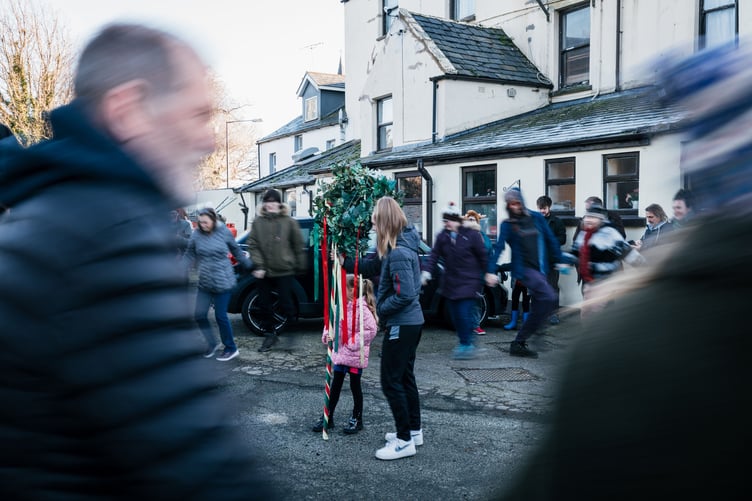
For many years I joined friends on the hillside ‘Hunt the Wren’, led by an old friend of mine, Willie Kneale, who I miss very much.
We would set off between 9.30am and 10am—sometimes a bit of a challenge after a hectic run-up to Christmas and the festivities of the day itself—and our visits to houses all around the area had to be concluded by midday. It is always held on St Stephen’s Day, otherwise known as Boxing Day, December 26.
The practice of Hunt the Wren was first noted in the 1720s, when it was remarked as having been practised since “time immemorial”.
The melody of ‘Hunt the Wren’ was first printed in 1820, and the words appeared in print in 1845. There were a number of versions of the song around at that time.
The version in the Manx language appeared in A. W. Moore’s Manx Ballads and Music in 1896, created from a combination of oral collection and ‘re-translation’ from the English.
It was noted there of an earlier 1843 version of the song that, from its form, it is clearly itself a literal translation of the Manx. It is this version, along with elements of A. W. Moore’s earlier printed version, which today forms the basis for the standard set of words sung.
The activity was popular in the 1880s, with about 30 sets of ‘Hunt the Wren boys’ going around Douglas alone in 1884.
In the early 1900s the practice remained common, with numbers of separate groups going around to hunt the wren in Onchan, Douglas, Peel, Port St Mary, and Kirk Michael, and one group hunting in Ramsey.
Despite some reports of it ‘dying out’ in the 1930s, the Daily Times reported in 1937 that the practice of singing around the houses with the wren pole was still taking place in 1975, though it was said to be done only by children in Peel (well done, Peel!) and occasionally in other places.
However, with the Manx cultural revival of the 1970s, the dance was reintroduced into the practice, and it is in this form that the custom has since become re-established.
Today the tradition is flourishing, with Hunt the Wren taking place in a number of towns and villages around the island.
As many as 80 people attend the event in Port St Mary alone, and it also takes place in Douglas, St John’s, Ramsey, Kirk Michael, Ballaugh, Laxey and Sulby.
Many of the groups are underpinned by Manx dance groups, such as Perree Bane in Port St Mary and the Manx Folk Dance Society in Douglas. These days, collections are made for charities such as the lifeboats.
Ribbons are taken from the wren pole for good luck—I remember the red ribbon was the most popular.
For the last couple of years I have attended the Cammag (similar to shinty) at St John’s.
It is, without doubt, full-on fun! With in excess of 50 players using the camman (stick)— ‘a little curved thing’ —and a ball, in Manx ‘cric’.
Historic commentary cites matches with any number between four and 200 players. It is played between teams from the north and the south, who do not hold back in their enthusiasm.
The Manx word ‘cammag’ is derived from the Gaelic root word ‘cam’, meaning bent.
The sport may have been introduced to the Isle of Man by Irish missionaries in the 5th century. The earliest written record of the game dates to 1760, when three men and a boy were brought before the church court for playing cammag on a Sunday.
References to cammag in the press first appear in 1843, when an attempt to ban the sport from being played within towns was reported by the Manx Sun.
Further complaints were reported in 1846, 1851, 1869, 1871, and 1884.
It appears that during this period the sport was mainly played in an unorganised fashion by young boys. However, on March 14 1885, the Isle of Man Times reported that the ‘ancient game of cammag’ had been revived at Mooragh, Ramsey.
In 1895, a letter to the Isle of Man Examiner reported that a cammag club was to be established in Foxdale. It is also stated that between 1894 and 1901 the game was played during the winter at the Isle of Man Lunatic Asylum.
As hockey became established in the early years of the 20th century, it supplanted cammag.
However, games of cammag were played again in 1937 as part of Hollantide Night festivities held by Aeglagh Vannin, and in 1938 a camogie exhibition match was played in Noble’s Park as part of the Celtic Congress held in the island.
Research by David Fisher clarifies that the Northern Railway line historically ran from the Grand Island Hotel to Niarbyl, south of Peel. When looking for a referee at this year’s match, David suggested an ex-minister might wish to fulfil the role—to which he (me) quickly disappeared!
During the early 2000s, the match was refereed by the presenter of Manx Radio’s folk show, the late John Kaneen.
The game usually revolves around a central pack, where a large number of players are confined in a small space and the ball cannot move large distances.
Breakout attacks down the open wings occasionally take place, though the large number of players in the centre of the field makes it difficult to attack the staked-out goals from outside positions.
At the game’s conclusion, players, supporters, and musicians retire to the Tynwald Inn for a festival of Celtic music and refreshments. I must go next year!
Finally this week, let’s hope for a peaceful, happy, and healthy 2026.
Let’s start it off once again with the St John’s Fell Race on January 1, starting at 1.30pm.
I have been involved for many years, and it is a fantastic event for fun runners and serious competitors alike.
Thousands of pounds have been raised for charities over the years. Proceeds from this year’s event will be donated to the Manx Heart Foundation, in tribute to the late Phil Motley, who sadly passed away in March this year and was a very popular member of Manx Fell Runners.