
Are you enjoying the World Cup, or is your home a World Cup-free area?
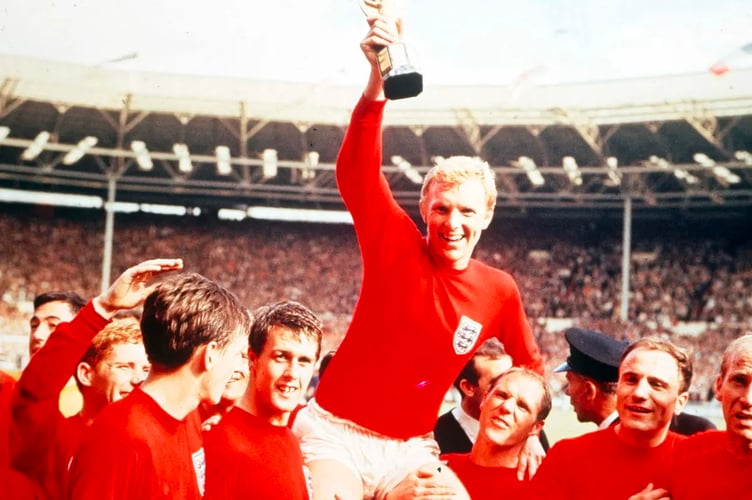
If the latter, I apologise as I take a nostalgic look back to 1966 in London, 60 years ago, when we huddled around our televisions to witness, in glorious black and white, the victorious England side, led by Bobby Moore, defeating West Germany in the final.
The first World Cup was held in Uruguay in 1930.
Every match was played in the capital city of Montevideo, unlike this year's tournament, which is being held across three countries.
The host nation won the final against fierce rivals Argentina 4-2 at the newly built Estadio Centenario.
Brazil has won the World Cup more times than any other nation, securing the trophy in 1958, 1962, 1970, 1994 and 2002. Germany and Italy have each won it four times, Argentina three times, and France and Uruguay twice.
The Jules Rimet Trophy was originally named simply ‘Victory’ or ‘Coupe du Monde’ and was designed by French sculptor Abel Lafleur.
It depicts Nike, the ancient Greek goddess of victory, holding a decagonal chalice aloft. It was crafted from gold-plated sterling silver and rests on a blue lapis lazuli base.
In 1946 it was officially renamed to honour the visionary FIFA president who founded the tournament.
It has something of a colourful history. During World War II, the trophy was stored in a bank vault in Rome. Fearing the Nazi troops would confiscate and melt down the gold, the Italian vice-president of FIFA, Ottorino Barassi, secretly smuggled the trophy out of the bank. He hid it safely in a shoebox underneath his bed for the duration of the war.

.jpeg?width=209&height=140&crop=209:145,smart&quality=75)

.jpeg?width=209&height=140&crop=209:145,smart&quality=75)
On to London in 1966. Four months before the World Cup, the trophy was stolen whilst on public display at Westminster Central Hall.
The thieves ignored stamps worth millions and took only the trophy, triggering a frantic Scotland Yard investigation and a failed ransom exchange.
Seven days later, a dog named Pickles became an international hero. Do you remember why? While out on a walk with his owner in South London, Pickles sniffed out a package wrapped tightly in newspaper and hidden beneath a suburban garden hedge. It was the intact Jules Rimet Trophy.
When Pelé and Brazil won their third title in Mexico in 1970, FIFA rules meant that the nation could keep the trophy permanently, and it was taken home to Rio de Janeiro. FIFA subsequently commissioned the brand-new FIFA World Cup Trophy.
On December 19 1983, thieves used a crowbar to pry open the wooden rear of a bulletproof display cabinet at the Brazilian Confederation headquarters.
The original Jules Rimet Trophy was never seen again. While four men were eventually convicted of the crime, investigators widely believe the priceless piece of sporting history was melted down into gold bars and sold on the black market.
Today, only a small part of the original remains: the lapis lazuli base, which FIFA had safely stored in a basement storage room in Zurich. The Brazilian federation now displays a gold-plated replica.
Back to London in 1966... Who remembers World Cup Willie?
He was the first-ever official mascot for a FIFA World Cup and pioneered the entire concept of sports merchandising. Willie was a cartoon lion (representing the British Three Lions) wearing a Union Jack jersey proudly displaying the words ‘World Cup’. He even had his own song recorded by Lonnie Donegan.
How about the memorabilia? Pin badges, beer mats, toffee tins, lollipops, toys, clothing and much more!
One thing I thought was from 1966, and which deserves a mention even though it was actually 1970, was calling into the petrol station and getting one of the Esso World Cup coin collection tokens.
To mark England heading to the 1970 tournament in Mexico, Esso petrol stations launched a massive promotion.
Motorists were given one free solid metal coin for every four gallons of petrol they purchased.
There were 30 coins to collect in total, each featuring a raised engraved portrait of an England squad member alongside their name and a facsimile of their autograph. I remember lobbying family members to donate their coins to my collection!
In 1966, England, managed by Sir Alf Ramsey, progressed through the tournament undefeated, conceding only three goals across six matches.
In the group stage, England topped their group with two wins and a draw. The opening match against Uruguay ended 0-0, a tense and frustrating contest at Wembley Stadium.
Next came a 2-0 victory over Mexico, with Bobby Charlton scoring a spectacular 30-yard screamer to ignite England's tournament, followed by a goal from Roger Hunt. England then defeated France 2-0, with Roger Hunt scoring twice to secure safe passage to the knockout rounds.
The quarter-final resulted in a 1-0 victory over Argentina in an ill-tempered match. Geoff Hurst, who came into the side to replace the injured star striker Jimmy Greaves, scored the winning header.
In the semi-final, England finally conceded their first goal of the tournament, but not before Bobby Charlton had scored two brilliant goals to put the hosts ahead. A late penalty from Portuguese superstar Eusébio wasn't enough to stop England reaching their first-ever World Cup final.
Ninety-six thousand fans packed Wembley Stadium for the most famous match in English football history, the World Cup Final on 30 July 1966. Were any readers lucky enough to be there? Or were you one of the 32 million viewers in the United Kingdom, or 400 million worldwide, like me?
The score at the end of normal time was 2-2. Helmut Haller put West Germany ahead early, but Geoff Hurst equalised. Martin Peters put England 2-1 up in the 78th minute, only for Wolfgang Weber to score a heart-breaking equaliser in the 90th minute and force extra time.
In extra time, Geoff Hurst scored his legendary and still heavily debated 'ghost goal', which bounced down off the crossbar and was ruled by the linesman to have crossed the line.
In the final seconds, as fans began running onto the pitch, Hurst smashed home his third goal to complete the only hat-trick ever scored in a men's World Cup final.
Everyone remembers the most famous commentary line in broadcasting history by BBC commentator Kenneth Wolstenholme.
In the final seconds of extra time, as Geoff Hurst carried the ball forward into the penalty area, fans began spilling onto the pitch, believing the referee had already blown his whistle. Wolstenholme calmly described the scene:
‘And here comes Hurst...He's got...some people are on the pitch...they think it's all over... it is now! It's four!’
Sir Geoff Hurst is the sole surviving member of England's starting eleven and is now aged 84.
Two other squad members who played in earlier games, but not the final, are also still alive.
Terry Paine, now 87, played in the 2-0 victory over Mexico, while Ian Callaghan, now 84, played in the 2-0 victory over France.
After a long campaign against an outdated FIFA rule, England's reserve and squad players finally received their medals in 2009.
The original rule had specified that only the starting eleven would receive medals. In 2007, FIFA officially altered its policy to recognise the entire 22-man squad.
Family members accepted medals on behalf of squad members and staff who had passed away, including the family of Sir Alf Ramsey. So well deserved.